

Impact.com grew up as a partnership automation platform for affiliates and publishers, and it added creator tools in August 2020 when it acquired ACTIVATE, an influencer platform. Brands start comparing Impact alternatives when their partner revenue shifts toward creators.
The daily work shifts with it. Your team spends its days shipping product and chasing drafts from dozens of creators, inside a system organized around partner contracts and conversion tracking.
The revenue case for creators is strong. Upfluence analyzed 1.1 million affiliate-linked posts published between June 2025 and April 2026: creator affiliate content matched organic engagement at almost every follower tier and cost a fifth to a third less than paid social.
We built Upfluence, one of the eight platforms in this guide. Every other tool is described from its own public positioning.
TL;DR
Impact.com is an established partnership and affiliate management platform. Most teams that replace it want a lighter commerce setup or deeper creator-program execution; a few want access to an existing affiliate network instead.
- For an end-to-end creator plus affiliate program tied to revenue, look at Upfluence, Grin, and Aspire.
- For reach into an established affiliate or SaaS-partner network, look at Awin, PartnerStack, and Refersion.
- For enterprise governance or creator-side monetization, look at CreatorIQ and ShopMy.
| Platform | Built for | Type |
|---|---|---|
| Upfluence | Ecommerce and agency teams tying creators and affiliates to revenue | End-to-end creator marketing with payments and attribution |
| Grin | Shopify-centric DTC brands running creator ops in house | Creator management with affiliate and payouts |
| Aspire | Brands scaling ambassadors and word-of-mouth commerce | Marketplace and community with affiliate workflows |
| Awin | Brands wanting an established global affiliate network | Affiliate network and publisher access |
| PartnerStack | B2B SaaS running channel and referral programs | Partner relationship management with a B2B network |
| Refersion | Shopify stores launching a lean affiliate program | Affiliate tracking and management app |
| CreatorIQ | Enterprises needing governance and measurement at scale | Enterprise creator marketing suite |
| ShopMy | Brands tapping creators who already monetize with links | Creator-side storefronts and affiliate links |
Why Teams Switch From Impact.com
Impact.com runs every partner type from one dashboard. On its own site, the performance platform is split into six modules: Discover and Recruit, Contract and Pay, Track, Engage, Protect and Monitor, and Optimize.
For a company managing hundreds of partners of different kinds across regions, that coverage pays for itself. Switching usually starts when a program stops looking like that. Two specifics come up most often.
Creator tools were added to a partnership core. The creator product came from the ACTIVATE acquisition, and Impact.com describes it as integrated with its performance platform. The records the platform is built around are partner contracts and tracked conversions. A creator team’s week goes somewhere else: outreach and follow-ups first, then product seeding and content approvals.
Setup is sized for many partner types. Contract terms and payout events need configuring, and so does tracking across every property. With 400 publishers, that structure earns its keep. With 40 creators selling through one Shopify store, it is a lot of configuration for a two-person team to own.
If most of your growth comes from creators promoting products on commission, the main objective of your platform should be commerce and payouts. The platform should tell you which creator drove which sale, and whether that sale netted a return, without a reporting project.

How to Choose an Impact.com Alternative
Impact.com reached creator marketing by expanding a partnership tool. Upfluence was built for creator marketing from the start. We have been building it since 2013, and our AI agent draws on that campaign history.
Whichever tools make your shortlist, start with the question that rules out the most options: the store connection.
Does It Connect to Your Store and Attribute Sales Back?
Check for native connections to the tools you already sell through, such as Shopify, Amazon, WooCommerce, Magento, and BigCommerce. Then check that results flow back to those orders. Swapping a commerce tool later is slow and expensive, so a platform that fails here is out.
Can You See Which Creator Moved Revenue?
A dashboard can display a lot and still leave the key answer buried. Look for a platform that ranks partners by tracked sales, average order value (AOV), and customer lifetime value (LTV), so the reinvestment decision is obvious. Upfluence’s own affiliate engagement study found that tracked affiliate links do not cost creators engagement, so measuring by sales does not hurt reach.
How Many Hours Go Into Manual Reporting?
Count the hours your team spends exporting and stitching numbers from separate tools each month. Every one of those hours comes out of recruiting creators or reviewing their content.
Does the Platform Learn From Your Results?
Treat this one as optional, though it is where platforms actually differ: the stronger tools use your historical results to suggest lookalike creators or campaign parameters that already worked for you.
Ready to see how this looks on real numbers? Get Started and book a walkthrough of how Upfluence connects creators and affiliates to tracked sales.
The Best Impact.com Alternatives for Affiliate and Creator Programs
Upfluence
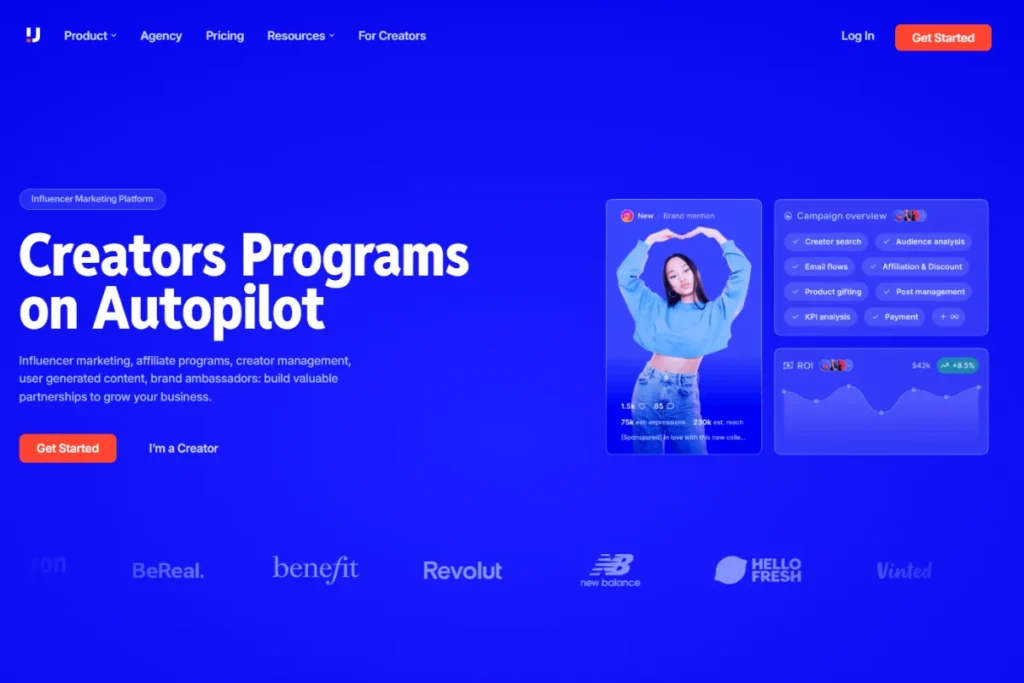
Upfluence is built for ecommerce and agency teams whose affiliates are mostly creators. One platform covers the program from first outreach to final payout:
- Commerce attribution. Native commerce integrations with Shopify, Amazon, WooCommerce, Magento, and BigCommerce tie clicks, conversions, AOV, and LTV to the creator or affiliate who drove them.
- An agent that reads the numbers. Upfluence AI (Jaice) reviews campaign analytics and recommends which creators to pick, which campaign type to run, and how much budget it takes to hit a target. A small team can operate like one 10 times its size, with people still approving strategy and content.
- Payouts with no revenue share. Bulk creator payouts go out in one click across currencies, with W-9, W-8, and 1099 collection handled automatically. Upfluence takes no percentage of creator-driven sales.
- Live Capture. The feature flags existing customers who are also creators, so you can invite those customer-creators into your campaigns.
Valabasas reported a 14x return after moving its influential customers into a creator affiliate program, and MercerLabs reported 6x. Both figures are customer-reported.
One limit to know: a brand that only needs a searchable creator database will pay for workflow it never uses.
Grin
Grin is purpose-built for DTC ecommerce and sits closest to Upfluence in philosophy. Gifting and affiliate payouts run on a Shopify-centric setup with no middleman, and premium DTC brands use it to keep creator operations in house.
The two diverge on sourcing. Upfluence adds outbound discovery across a marketplace of more than 14 million creators, Live Capture for customer-creators, and an AI agent that handles follow-ups and surfaces content waiting for approval.
If your roster already comes from people who know your brand, Grin covers the job well.
Aspire
Aspire, formerly AspireIQ, made its name on inbound. Creator applications, ambassador programs, and UGC (user-generated content) workflows sit alongside managed services and a deep Shopify integration.
Brands with an active community often fill most of a roster this way. Inbound applicants do not always match a narrow niche, though, so teams in specialized categories tend to add outbound discovery and automated outreach. That is where Upfluence comes in, and it also handles attribution and payouts when the roster spans several countries.
Awin
For a team that picked Impact.com mainly for publisher reach, Awin is the most direct swap. Awin is one of the largest global affiliate networks, now including ShareASale, and its publisher base is strongest in retail and travel.
The upside is speed: you plug into publishers who already exist. Day-to-day creator relationships stay with your own team. Brands running a hands-on creator roster often use a network for publishers and a creator platform for everything else.
PartnerStack
PartnerStack is a partner relationship management platform for B2B SaaS. PartnerStack handles referral and reseller partners alongside affiliates, and its network is made up of partners who specialize in promoting software.
A later-stage SaaS company running a structured channel program will get the most from it. An ecommerce brand selling through creators with discount codes and product seeding is outside what it was designed for.
Refersion
Refersion is an affiliate tracking and management app popular with Shopify, BigCommerce, and WooCommerce stores. Brands pick it for a quick launch and its publisher marketplace.
Check the pricing model before you scale. Refersion’s published plans pair a monthly subscription with a percentage of affiliate-driven sales (verified September 2026 on its own pricing page), so the bill grows with every sale.
Refersion also stays focused on affiliate tracking. Discovery and outreach happen in other tools.
Comparing total cost as your program grows? See plans and pricing to weigh a platform fee against a percentage of sales.
CreatorIQ
CreatorIQ is an enterprise creator-marketing suite for large brands and agencies. Its strengths are governance and measurement at scale.
An enterprise that uses Impact.com chiefly to govern a large creator program will find the most overlap here. Mid-market and ecommerce teams usually weigh it on setup time and total effort.
A lighter platform owned by the marketing team can tie creators to revenue without a dedicated operations function, though it gives up the approval chains a multi-brand enterprise needs.
ShopMy
ShopMy works from the creator side of the market. Creators, especially in fashion and beauty, build digital storefronts there and earn on auto-monetized links.
Premium creators like it for exactly that, and its creator network is something Upfluence does not replicate.
Brands use ShopMy to reach creators who already sell through links. Running the campaigns still takes a brand-side workflow, so many brands pair ShopMy with a platform like Upfluence.
How to Tie an Affiliate Program to Revenue
A program that cannot map a sale back to a partner is a cost center hoping it works. Build attribution you control first:
- Unique tracking links for each creator.
- Discount codes tied to each creator.
- UTM parameters on shared links, feeding a dashboard that reports revenue, orders, AOV, and LTV by partner.
- A ranking by return. A micro-creator with a 6x return is worth more to the program than a celebrity post that only drove awareness.
Audience size is a weak predictor on its own. In an Upfluence analysis of 10.9 million creator profiles active in Q2 2026, median Instagram engagement fell from 2.5% for nano creators (under 10K followers) to 0.8% for mega creators (1M+). Upfluence’s revenue and ROI attribution ranks creators by what they sell and links straight through to payouts.
Do the ROI math with the brackets in place: ROI = ((return minus cost) divided by cost) times 100. Net out cost first, divide, then multiply.
Link-and-code attribution undercounts. Some buyers see a post, search for the brand a week later, and buy without clicking. Treat the measured number as a floor.
Then check how the platform charges as you win. A fee based on a percentage of creator-driven sales rises every time a campaign works, while a platform fee stays predictable.
Upfluence handles bulk payouts with tax forms built in, so payouts and the sales behind them sit in one report for ecommerce creator programs.
How to Keep the Program Safe and Compliant
Brand safety covers two separate risks:
- Audience authenticity. Across nearly 4 million Instagram creator profiles analyzed by Upfluence, the median profile carries an estimated 7% fake followers, and 1 in 16 shows more than 25%. Screen before you pay for reach.
- Reputational protection. Avoid creators who promote off-brand or risky content, such as drugs or alcohol.
Affiliate links also carry a disclosure obligation, and the rules differ by market:
- United States: the FTC’s disclosure guidance sets the baseline.
- United Kingdom: the ASA and CMA publish their own influencer guide.
- Canada: the Competition Bureau and Ad Standards set the rules.
One market’s rule never covers the others. For your specific situation, check with your own legal advisor.

Frequently Asked Questions
What is the best Impact.com alternative for a small ecommerce brand?
For a lean DTC brand on Shopify, look at platforms whose main objective is commerce and payouts: Upfluence or Grin for a full creator program, or Refersion for a simple affiliate-only start. Deciding whether you need a creator workflow or just an affiliate tracker narrows the list fast.
Do any Impact.com alternatives avoid taking a percentage of sales?
Yes. Upfluence charges for the platform and takes no cut of creator-driven sales, so cost stays predictable as campaigns scale. Some affiliate apps pair a subscription with a percentage of affiliate-driven revenue, so confirm each vendor’s current model before you commit.
Can an Impact.com alternative handle both affiliates and creators?
Yes. Impact.com itself spans both, and Upfluence, Grin, and Aspire also run affiliates and creators in one workflow. Discount codes and tracked links feed the same revenue report, so you are not managing two disconnected programs.
How do these platforms attribute creator sales?
Most assign unique promo codes, affiliate links, or UTM parameters to each creator, then map conversions back through those identifiers. That method misses view-through sales, so pair it with mention tracking and a “how did you hear about us” survey for a fuller picture.
The Right Impact.com Alternative for Your Program
Impact.com remains a capable choice for broad, enterprise-scale partnerships across many partner types. When growth runs through creators and affiliates driving tracked sales, pick a platform that reports revenue by creator by default and keeps its fee flat as you succeed.
Match the tool to your model:
- End-to-end creator platform when you want discovery, execution, attribution, and payments in one place.
- Affiliate network when publisher reach is the priority.
- Creator-side network when you want to meet creators where they already monetize.
A short walkthrough on your own numbers shows attribution and payouts on real creators before you switch anything.
See how Upfluence ties creators and affiliates to revenue. Get Started with a walkthrough built around your program.