

CreatorIQ is influencer marketing software built for large companies that run creator programs across several brands and countries. The platform controls who approves each campaign and records every decision.
If you run influencer marketing at a single brand, or manage campaigns for clients at an agency, you may be paying for controls you never touch. When someone asks which creator drove last month’s sales, the answer can still end up in a spreadsheet.
We built Upfluence, one of the 7 CreatorIQ alternatives compared here. After more than a decade of running creator programs with ecommerce brands and agencies, we say plainly where Upfluence helps and where another tool does the job better.
TL;DR: CreatorIQ Alternatives by Team Type
The answer depends on how your team works and where your sales happen:
- CreatorIQ is still a strong choice if you manage several brands and need sign-off on every campaign.
- Traackr is the closest enterprise match, for global brands measuring creator impact across markets.
- Kolsquare is the European specialist, strongest where GDPR shapes vendor choice.
- Later Influence works for social media teams that already schedule their posts in Later.
- Upfluence and Grin are built for online stores that need to see which creator drove each sale.
- Aspire brings inbound applications and managed services to brands growing an ambassador community.
- Modash gives you a large, searchable creator database on self-serve plans.
Where CreatorIQ Earns Its Enterprise Price
Know what you would give up first.
CreatorIQ is strongest in these areas:
- Governance: Admins decide who can approve and publish campaigns in each brand and region.
- Fraud detection: The platform flags signs of fake followers and suspicious engagement.
- Earned-media measurement: It estimates the value of the free exposure that creator posts generate for your brand.
- Cross-channel reporting: It pulls results from different social platforms into a single report.
- Integrations: It connects with the major social platforms and other marketing tools.
That level of control matches the money now flowing through creator marketing. US influencer marketing spending passed $10 billion in 2025, according to eMarketer’s estimate.
A company spending at that scale across 5 business units needs a clear record of who approved what, and CreatorIQ provides one.
So if you run several brands and a compliance team signs off on every campaign, staying with CreatorIQ is a reasonable choice.
The picture changes for a single-brand online store. Approval layers built for a multi-brand company go unused, yet they still shape how the platform is set up.

How to Judge a CreatorIQ Alternative
Use these checks in every demo. Start with the store connection, because it rules out the most platforms.
Check Commerce Integration
Your online store is where sales happen, so a platform has to connect to it before anything else matters. Ask whether it integrates with Shopify, Amazon, WooCommerce, Magento, or BigCommerce.
Switching store platforms is slow and costly. Cut any tool that can’t read yours.
Test How Precisely It Credits Each Sale
Attribution is what makes your ROI figure trustworthy.
ROI equals ((return minus cost) / cost) times 100, and that formula is only as reliable as the return figure you feed into it.
In a demo, pick one sale from last month and ask the vendor to show you which creator gets the credit.
Follower counts muddy this. Engagement rate tends to fall as an audience grows.
An Upfluence analysis of 10.9 million creator profiles on Instagram, TikTok, and YouTube found a median Instagram engagement rate of 2.5% for nano creators, who have under 10,000 followers. For mega creators, who have over 1 million followers, the median was 0.8%.
So a report built on follower counts can rank your creators very differently from one built on sales.
Count the Manual Reporting Hours
Accurate attribution still costs you time if the numbers live in different places. Ask how much of your week goes to exporting data from separate tools and matching it up by hand.
If you want to skip that step, Upfluence’s creator analytics shows the sales each creator drives in one report, whether you run your own brand or report to agency clients.
Run Creator Vetting on Every Platform
Test how each platform screens for both brand-safety risks:
- Fake audiences: Across nearly 4 million Instagram creator profiles analyzed by Upfluence, the median profile carried an estimated 7% fake followers. One in 16 profiles showed an estimated fake share above 25%.
- Off-brand content: Some creators promote alcohol, gambling, or other content your brand shouldn’t be linked to.
Disclosure rules also differ by market. In the US, the FTC expects creators to clearly disclose any material connection to a brand, such as payment or free products.
The UK has its own rules from the ASA and the CMA, and Canada’s come from the Competition Bureau.
Ask each vendor how it helps you track disclosure in the markets you sell into.
Ask Whether It Learns From Your Results
Optional but useful: a strong platform uses your own campaign history to suggest creators similar to the ones who already sold for you.
Compare the 7 CreatorIQ Alternatives at a Glance
| Platform | Built for | Pricing model | What stands out |
|---|---|---|---|
| Upfluence | Online stores and agencies judged on sales | Custom quote and no commission on creator sales | Store sales tracking and a built-in agent for creator follow-ups |
| Traackr | Global beauty, fashion, and consumer brands focused on measurement | Annual plans from $20,000 per year | Compliance workflows, reputation-risk screening, and competitor tracking |
| Kolsquare | European programs with strict data-privacy needs | Custom quote | A European market benchmark and guidance on European and UK influencer rules |
| Later Influence | Social media teams that also schedule posts | Custom quote | Influencer tools in the same suite as post scheduling |
| Grin | Shopify-based online brands | Custom quote | Gifting, affiliate payouts, and sales tracking built around the store |
| Aspire | Brands building a long-term creator community | Custom quote | Inbound creator applications and managed agency services |
| Modash | Teams that mainly need creator search | Self-serve plans and a 14-day free trial | Over 250 million searchable creator profiles |
CreatorIQ Alternatives That Keep Enterprise Controls
These 3 platforms are for teams that still need CreatorIQ-level measurement and approvals. They make sense when your reason for switching is regional focus or how your team publishes content.
1. Traackr
Traackr is the closest match to CreatorIQ for large brands that need a central record of every creator relationship. Its compliance workflows and reputation-risk screening are strong. Traackr also tracks how competitors work with creators around the world.
Its pricing page speaks directly to beauty, personal care, fashion, spirits, and consumer electronics brands.
Traackr also publishes its starting prices, so you can estimate the cost before a sales call:
- Growth: Plans start at $20,000 per year for a minimum of 3 users.
- Plus: Plans start at $55,000 per year for a minimum of 10 users. Traackr’s data-access add-ons start at this tier.
That last point matters if you plan to send creator data into your own reporting tools or an AI assistant. Price out that access early.
Traackr works from a smaller pool of creators than platforms that let you search the open web, which can limit your options in narrow niches.
2. Kolsquare
Kolsquare is a Paris-based platform with deep expertise in European regulation: it publishes a State of Influencer Marketing in Europe benchmark and co-authored a guide to EU and UK influencer rules.
For a European program, its approach to GDPR is a sound reason to shortlist it.
Its market focus is Europe. A brand that sells mainly through US or Canadian stores on Shopify or Amazon will want proof that attribution works on those stores.
3. Later Influence
Later Influence, formerly called Mavrck, is the influencer part of Later’s social media suite. The same suite handles post scheduling and Link-in-Bio.
If your social team already publishes through Later, you get one login for scheduled posts and creator campaigns.
Check discovery. Later draws from an opted-in index, so you can only find creators who have signed up to it.
A quick search in your narrowest niche (vintage audio gear or plus-size running apparel, for example) shows how deep that index goes for you.
CreatorIQ Alternatives for Ecommerce and Mid-Market Teams
The remaining 4 platforms serve mid-sized teams whose creator budget is judged on store orders.
4. Upfluence
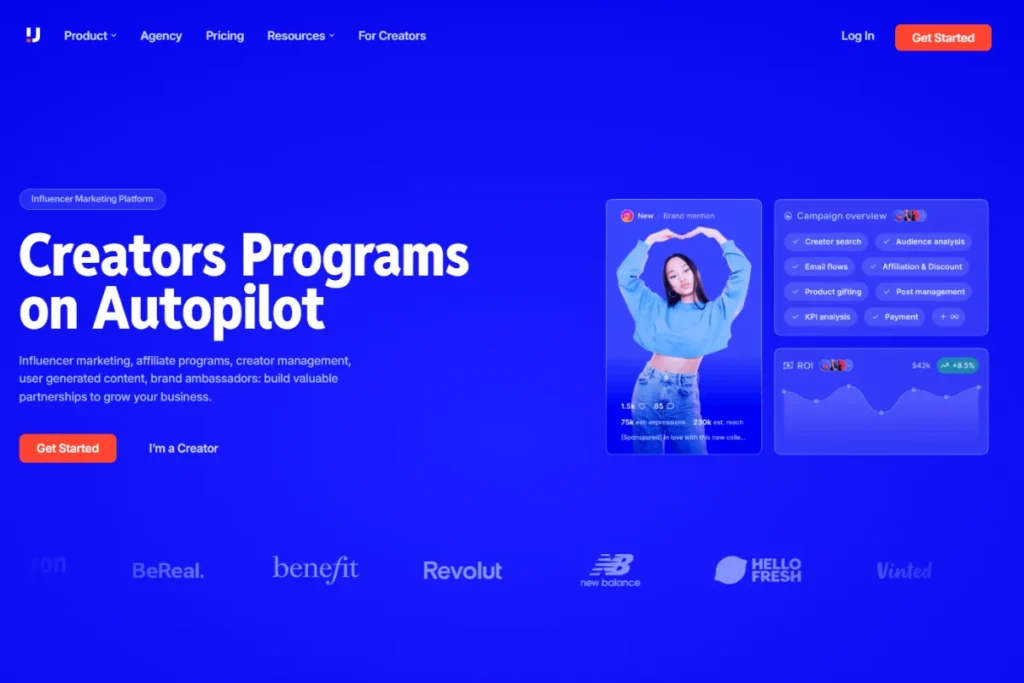
Upfluence is an influencer and affiliate marketing platform for ecommerce brands and agencies, covering the whole program from finding creators to paying them.
The part that differs most from CreatorIQ is Upfluence AI (Jaice), our AI agent.
The agent reads your campaign results and recommends which creators to pick, which type of campaign to run, and what budget it will take to hit your target.
The agent also handles follow-ups, which is where creator programs tend to lose weeks. Drafts and replies get chased automatically, and the content waiting on your approval surfaces in one place.
Upfluence’s co-CEO told Net Influencer that outreach emails written by Upfluence AI (Jaice) earned a 22% higher reply rate than human-written ones from the same campaigns. The same report says the agent helped brands hire 160,000 creators in 2025.
Your team keeps strategy and approvals. The agent takes on the repetitive work, which lets a small team run a program 10 times its size.
Beyond the agent, the platform covers these parts of a creator program:
- Store tracking: Upfluence connects natively to Shopify, Amazon, WooCommerce, and Magento. For stores without a direct connection, Agnostic Sales Tracking creates affiliate links that still credit each sale.
- Live Capture: This feature finds existing customers who are also creators, people who already bought from you with their own money. You can then invite them into your campaigns.
- Klaviyo matching: Upfluence scans your Klaviyo subscriber lists for creators and adds the matches back to a list you choose.
- Upfluence Marketplace: Creators can find your programs and apply to join them. That brings in creators you didn’t have to search for.
- Upfluence Pay: It pays creators worldwide and handles identity checks and tax forms. Upfluence takes no percentage of creator-driven sales.
Upfluence is the wrong pick when a program has no sales target. For an awareness push on a product that isn’t sold online, you would pay for sales tracking and payout tools you won’t use.
Pricing is custom. Quotes depend on the modules and seats you need.
If you run creator programs for your own store or for clients, see how Upfluence ties creator posts to ecommerce sales.
5. Grin
Grin is a creator management platform built for DTC brands, with deep store integration and premium ecommerce brands on its roster.
Grin is Shopify-first. Gifting and affiliate payouts run inside the store workflow, so for a Shopify brand creator work feels like part of the business.
If you also sell on Amazon or through a second store, raise it early in your talks with Grin.
6. Aspire
Aspire, formerly called AspireIQ, is a mature platform known for strong inbound applications and managed agency services.
Aspire also supports UGC workflows for brands that want creator content to reuse in their own channels.
Aspire is strongest for brands building a long-term ambassador community. Its model is marketplace-first: creators apply, you approve.
That works well in broad categories. In a tight niche, fewer of the right creators may apply on their own. A lean team may also spend more hours reviewing applications and messaging creators one by one.
7. Modash
Modash is for teams that mostly need to search for creators. Its database covers over 250 million creator profiles across Instagram, TikTok, and YouTube.
Modash publishes self-serve plans and offers a 14-day free trial that doesn’t require a credit card.
Modash also includes a Shopify integration and creator payments, while affiliate management is available on its Performance Annual and Enterprise plans.
Teams that contact creators in high volume, or sell beyond Shopify, should look closely at how far its campaign tools go.
Match a CreatorIQ Alternative to Your Team
Find the row that matches your team, then use the last column as your test in each demo:
| If your team… | Shortlist | Test in the demo |
|---|---|---|
| Runs several brands with compliance sign-off on every campaign | Stay on CreatorIQ, or compare Traackr | Approval workflows and audit trails across brands |
| Runs a European program where data privacy drives vendor choice | Kolsquare | Attribution on your largest store |
| Publishes social content through one suite | Later Influence | Niche searches inside the opted-in index |
| Sells mainly on Shopify | Grin, Upfluence | Attribution on your top-selling product |
| Sells across Shopify, Amazon, and other stores | Upfluence | Attribution on every store you sell through |
| Wants a long-term ambassador community with agency help | Aspire | Applicant quality in your category |
| Mostly needs creator search on a self-serve budgeth | Modash | Search depth for your niche during the free trial |
Agencies, add one test. Check whether the platform keeps each client’s reporting separate, and ask to see two client workspaces side by side in the demo.

Frequently Asked Questions
Here are quick answers to common questions about switching from CreatorIQ:
Is CreatorIQ Worth It for a Mid-Sized Brand?
Only if your team uses most of it. Before renewal, count how many seats log in each month and how many campaigns go through formal approval. If both numbers are low, a lighter platform will likely cover your needs.
What Is the Most Affordable CreatorIQ Alternative?
Modash is the only one of the 7 you can buy self-serve, which usually makes it the cheapest way in. Traackr’s plans start at $20,000 per year. The other 5 quote custom prices, so ask what drives each bill, such as seats, creator searches, or payout fees.
Which CreatorIQ Alternative Works Best for Ecommerce Sales?
Upfluence and Grin both credit store orders to individual creators. Grin is built around Shopify. Upfluence also connects natively to Amazon, WooCommerce, and Magento, so the deciding factor is usually how many places you sell.
How Long Does Switching From CreatorIQ Take?
Plan a phased move. Export your creator lists, campaign records, and results before you give notice. Then move one program first and migrate the rest once its reporting checks out.
Do CreatorIQ Alternatives Offer a Free Trial?
Modash offers a 14-day self-serve trial. Traackr decides on trials case by case. Upfluence and the other platforms here work through a guided demo.
Final Thoughts on Switching From CreatorIQ
Ask each finalist for a reference customer whose store setup looks like yours, because a short call with them surfaces problems no demo will show.
If Upfluence makes your shortlist, you’ll be looking at an influencer and affiliate marketing platform built for ecommerce brands and agencies. Finding, tracking and paying creators all happen in one place.
Upfluence AI (Jaice) reads your results and suggests which creators to pick and how much to spend. The agent also follows up with creators for you, so a small team can run a bigger program. Because Upfluence connects to your online store, every sale traces back to its creator.
Get Started to see which creators drive your sales.