

Once an affiliate program grows past a handful of partners, spreadsheets stop working. Codes leak to coupon sites, and nobody can say for sure who drove which sale.
A platform fixes that, but choosing one is harder than it looks, because platforms differ widely in cost and in how much of the work they take off your team.
We compare 12 platforms here by the type of program each one serves, with published pricing and our view of where each falls short. We built Upfluence, one of the 12, and have run creator and affiliate programs with brands for more than a decade, so weigh our entry with that in mind.
TL;DR: The 12 Best Affiliate Marketing Platforms
Our short verdict on each:
- Upfluence: You can find creators, recruit them as affiliates, track their sales, and pay them in one place.
- ShopMy: Fashion and beauty brands get access to creators who already sell through ShopMy storefronts.
- Levanta: It earns its fee when a large share of your affiliate sales lands on Amazon.
- Refersion: Shopify brands can launch quickly, though the percentage fee grows with every sale.
- Tapfiliate: Flat, volume-based plans make it far cheaper than percentage-fee tools once affiliate revenue grows.
- Rewardful: It is the simplest choice for SaaS companies billing through Stripe or Paddle.
- Awin: You get a large publisher network, now including former ShareASale accounts.
- CJ Affiliate: Its long-running publisher base favors established brands running large programs.
- Rakuten Advertising: Enterprise retailers can bundle affiliate with their wider paid media.
- impact.com: Large companies can run every partner type under one contract.
- PartnerStack: B2B SaaS companies use it to manage resellers and referral partners.
- Everflow: Performance teams get deep attribution data in return for a six-month commitment.
Every platform here tracks links and pays commission. Some also find affiliates for you and approve their content before it goes live; others leave that work to your team.
See how Upfluence runs creator affiliate programs end to end. Get Started
The Four Types of Affiliate Marketing Platforms
Those differences sort affiliate platforms into four groups, each built around a different kind of partner program.
- Creator-led affiliate platforms: For brands whose affiliates are creators on Instagram, TikTok, or YouTube. Creator search and outreach sit alongside the tracking, since finding creators takes the most time.
- Self-serve tracking software: These tools track and pay affiliates you have already found, usually customers or newsletter subscribers. They are cheap and quick to set up. Recruiting is entirely on you.
- Affiliate networks: A network gives you access to coupon and review sites already registered with it. You pay a fee on every sale they generate.
- Enterprise partnership platforms: These run affiliates, resellers, and referral agencies from one system. Pricing is quoted and setup is a project, so they are overkill if affiliate is your only partner channel.

How to Choose an Affiliate Marketing Platform
Answer these before you book any demos.
- Where will your affiliates come from? Start here. The answer points you to one of the four types above and rules out the rest.
- What will it cost once the program works? Many platforms charge a monthly fee plus a percentage of every affiliate sale, which gets expensive as the program grows. A 3% fee on $500,000 of annual affiliate sales adds $15,000 to your bill. Ask each vendor at what revenue level they move you to a flat fee.
- Can it track sales everywhere you sell? Check that it integrates with every channel you use, whether that is Shopify, Amazon, WooCommerce, Magento, or BigCommerce. A tool that misses one channel will undercount your affiliates’ sales.
After that, check reporting by asking how many hours a month your team will spend exporting data by hand.
Every price quoted is the figure each vendor publishes on its own website at the time of writing, so check current pricing before you buy.
Best Affiliate Marketing Platforms for Creator-Led Programs
These three all recruit creators as affiliates. They differ in where the sales happen and how much of the program they run for you.
1. Upfluence
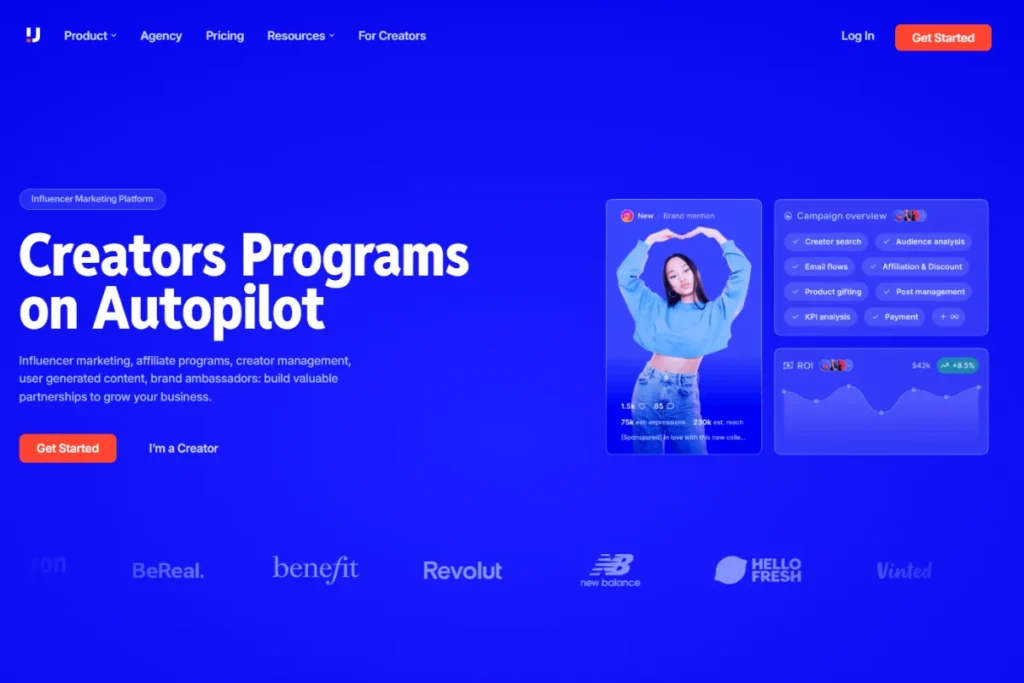
Upfluence runs the whole creator program on one platform, from finding creators to paying them. Affiliate tracking and payouts are built in, so the creator you recruit is the same record you ship product to and pay commission on.
Its most distinctive feature is Live Capture, which scans your customer list for people who are also creators. You can then invite them into a campaign as affiliates.
Fashion brand Valabasas used it to find more than 900 creators in its Shopify customer base. Inviting them as affiliates produced $165,000 in sales across three months at close to 14x return (customer-reported). Upfluence took no percentage of those sales.
For creators outside your customer base, Upfluence searches across 14M+ creator profiles.
For the day-to-day work, Upfluence AI (Jaice) acts as an agent inside the platform. The agent reads your campaign analytics and recommends which creators to recruit, which campaign type to run, and how much budget will hit your target.
The agent then sends invitations and follows up with creators while your team is offline. Your team still signs off on strategy and approvals. Anything that looks like a brand safety risk is flagged for a person to check.
Once creators are live, sales are tracked across Shopify, WooCommerce, Magento, BigCommerce, and Amazon. Upfluence Pay then sends bulk payouts in multiple currencies, collects W-9 and W-8BEN forms, and runs KYC checks. Upfluence takes no percentage of creator-driven sales.
Marriott and Universal are among its named customer references.
Pricing is modular and quoted to your program. Upfluence is more platform than you need, though, if you only want to track customers you already know. In that case, one of the self-serve tools below will cost less.
2. ShopMy
ShopMy lets creators earn commission through personal digital storefronts and auto-monetized links. Payouts run weekly.
Its strongest categories are fashion and beauty, where premium creators already run storefronts on the platform. If you sell in those categories, ShopMy belongs on your shortlist, because that ready-made network is hard for any brand-side tool to match.
Outside fashion and beauty, it is a harder sell. The platform is built for creators first, so brands that want campaign management or multi-channel attribution will find it thin. ShopMy does not publish brand-side pricing.
3. Levanta
Levanta is built for brands whose affiliate sales land on marketplaces. Levanta attributes creator-driven sales on Amazon, Shopify, and Walmart.
Published pricing is $750 per month on the Gold plan plus 3.5% of affiliate-driven sales. Enterprise pricing is custom and depends on program size and marketplace mix.
Levanta also offers a Shopify-only plan at $350 per month plus 4% of affiliate sales. That is higher on both counts than Refersion’s entry plan at $39 per month plus 3%, so a Shopify-only brand has little reason to choose Levanta.
Levanta is worth the money when Amazon is a large share of your revenue.
Best Affiliate Marketing Platforms for Self-Serve Tracking
Self-serve tools price in very different ways, so compare the figures side by side before you pick one.
4. Refersion
Refersion is affiliate tracking built for ecommerce stores. Refersion also runs a marketplace where affiliates can find your program. A basic listing there is free.
Published pricing is $39 per month on Launch plus 3% of affiliate-driven sales, or $199 per month on Growth plus 2%. Brands above $1M in annual sales can move to a flat-fee Scale plan.
The percentage fee is the number to watch on both plans. At $60,000 a month in affiliate sales, Growth costs $1,399 a month. That figure keeps climbing until you reach the Scale threshold.
5. Tapfiliate
Tapfiliate charges on traffic volume instead of a share of your sales. That makes it far cheaper than percentage-fee tools once affiliate revenue grows.
Here are its published plans.
- Launch: $89 per month covers one program, one team member, 50 affiliates, 5,000 clicks, and 500 conversions.
- Scale: $179 per month covers unlimited affiliates, 100,000 clicks, and 10,000 conversions.
- Enterprise: Pricing is custom.
Overages start at $1 per 1,000 clicks and $10 per 1,000 conversions.
Treat Launch as a trial, since 50 affiliates and a single team login run out fast. Scale is where Tapfiliate gets competitive. At $50,000 a month in affiliate sales, Scale costs $179 against $1,199 on Refersion’s Growth plan, as long as you stay under 10,000 conversions.
6. Rewardful
Rewardful is the simplest choice for a SaaS or subscription business billing through Stripe or Paddle. Rewardful handles recurring commissions natively, including trials and refunds. For a store selling physical products, it is the wrong tool.
Pricing runs $49 per month for up to $7,500 a month in affiliate revenue, $99 for up to $15,000, and from $149 above that.
Compare plans and see what a creator affiliate program costs at your scale. See plans and pricing
Best Affiliate Networks for Publisher Supply
Only Awin publishes its fees. CJ Affiliate and Rakuten Advertising quote each program individually, which makes them slower to test.
7. Awin
Awin is a global affiliate network with a large publisher base across retail, travel, and finance, and now includes ShareASale.
Awin moved ShareASale’s advertisers and publishers onto its own platform and closed ShareASale at the end of 2025. Any roundup still listing ShareASale as a separate option is out of date.
Published pricing starts at $49 per month on Access with a 3.5% tracking fee on every transaction, and Access carries a three-month minimum with 14 days’ cancellation notice. Accelerate starts at $99 per month with a 2.5% fee. Advanced is custom-priced.
Access is the cheapest way on this list to test publisher supply. Budget for the tracking fee, though. On $20,000 of monthly affiliate sales, Access adds $749 a month before you pay publishers a cent of commission.
8. CJ Affiliate
CJ Affiliate is one of the longest-running affiliate networks, known for large content and comparison publishers. CJ does not publish advertiser pricing and quotes each program individually.
CJ makes more sense for brands that already know affiliate works for them. If you are still testing the channel, Awin’s published Access plan lets you see the cost up front.
9. Rakuten Advertising
Rakuten Advertising pairs its affiliate network with display and broader performance media. Rakuten is mainly worth a look for enterprise retailers who want affiliate bundled into a wider media relationship. Rakuten Advertising does not publish advertiser pricing.
Best Enterprise Partnership Platforms
None of these publish pricing. Expect a sales call before you see a number.
10. impact.com
impact.com runs affiliates, influencers, B2B referral partners, and commerce content under one contract. Attribution rules and partner contracts are configurable.
impact.com is built for large companies with several partner channels, and for a brand running one affiliate program it is overkill. Pricing is quoted after a demo, and setup runs as an implementation project.
11. PartnerStack
PartnerStack is built for B2B software companies that sell through resellers and referral partners. Commission handling is designed for subscription revenue. Its partner marketplace helps you recruit new resellers.
If you sell physical products or work with creators, look elsewhere. PartnerStack lists Launch, Growth, and Enterprise tiers but confirms pricing only during a demo.
12. Everflow
Everflow is the most technical option in this group, with granular attribution for performance teams and agencies, including sub-affiliate tracking.
The six-month minimum commitment rules it out for a first program. Everflow does not publish pricing.
How to Vet Affiliates Before You Recruit Them
An affiliate who never sells costs you nothing in commission. They still cost staff time, because someone has to recruit them and then chase the content they promised.
Brands often worry that a tracked link or discount code will make a post look like an ad and cost the creator engagement. Upfluence analyzed 1.1 million affiliate posts on Instagram and TikTok and found that affiliate posts hold the same engagement as organic ones at every follower tier but one: TikTok creators above 1 million followers.
That leaves the creator’s audience as the thing to vet. These four checks catch weak candidates before you spend anything on them.
- Audience authenticity: Bought followers will not buy your product, and Upfluence’s analysis of nearly 4 million Instagram profiles puts the median fake-follower share at an estimated 7%. Run each prospect through a free fake follower check before you send anything.
- Engagement against audience size: A larger audience does not mean a more responsive one. Compare a creator’s engagement rate with others at a similar follower count.
- Brand safety: Check what else they promote. Alcohol, gambling, or anything age-restricted may sit badly next to your product.
- Buying audience: Check whether their audience buys in your product category. Past affiliate sales are the strongest predictor you have.
Once affiliates are live, sales and performance reporting shows you who to keep and who to drop.
Disclosure Rules Your Affiliates Have to Follow
Affiliates must tell their audience that they earn commission from you. Regulators call this relationship a material connection. The rules for disclosing it differ by market.
Here is what applies in the US, the UK, and Canada.
- United States: The FTC’s endorsement guidance for businesses says the relationship must be disclosed clearly and conspicuously. Plain wording such as “I get commissions for purchases made through links in this post” is acceptable. A bare “affiliate link” label is treated as insufficient.
- United Kingdom: Guidance from the Advertising Standards Authority and the Committee of Advertising Practice, produced with the Competition and Markets Authority, sets out how affiliate and sponsored posts must be labelled.
- Canada: The Competition Bureau has confirmed that the deceptive marketing provisions of the Competition Act apply to affiliate and influencer content.
Two rules hold in all three markets. First, put the disclosure right beside the recommendation, where readers see it before they click.
Second, a platform label does not replace a written disclosure. Instagram’s branded content tag and YouTube’s paid promotion box only cover each platform’s own policy, so regulators still expect a disclosure in the content itself.
Write the disclosure standard into your affiliate terms so partners know it before they post. Treat all of this as practical guidance. Check your own obligations with a qualified adviser.

FAQ
These are the questions brands ask us most often while comparing platforms.
Do I Need an Affiliate Platform if I Already Run Promo Codes in Shopify?
You need an affiliate platform once promo codes stop showing who drove each sale. Codes get shared on coupon sites, so credit goes to the wrong person. A platform also calculates commission and collects tax forms from affiliates abroad, which Shopify discount codes do not do on their own.
Can I Run Affiliate and Influencer Campaigns on the Same Platform?
Yes, and it is usually the better setup, since creators often start on a gifted campaign and move to commission once their content sells. One system shows you which gifted creators are worth converting.
How Do I Set Affiliate Commission Rates?
Start from your product margin and what a customer is worth to you over time. Then add your platform’s fees, because network and percentage-of-sales fees sit on top of the commission. Your real cost per sale is both figures together.
How Long Does an Affiliate Program Take to Produce Revenue?
As fast as you can recruit and activate affiliates. Tracking goes live within a day. Getting affiliates signed up and publishing usually takes several weeks, mostly because of content approvals and follow-ups.
Who Owns the Affiliate Relationship on an Affiliate Network?
The network does, because it holds each publisher’s account and most of the communication, so publishers stay with the network if your brand leaves. On a direct platform, your brand holds the contact details and agrees terms with each affiliate.
Run Your Whole Affiliate Program on Upfluence
Your platform choice sets a ceiling on growth. Switching later means re-recruiting every affiliate you signed, so a wrong choice gets more expensive every month.
On Upfluence, the whole program runs in one place, from finding creators to paying them, so it can grow without a migration.
Upfluence AI (Jaice) reads your campaign data. The agent tells you which creators to pick and what budget will hit your target, then sends the invites and chases follow-ups while you sleep.
Upfluence Pay handles bulk payouts in multiple currencies. Upfluence takes no cut of your creator sales.
Every month on spreadsheets is a month of affiliate revenue you cannot attribute. Get Started and see your program mapped out.