

Executive summary
This Black Friday checklist covers the creator side of the sale, from setting goals to the post-mortem, with a date for every phase this year. Black Friday 2026 is on November 27.
Last season’s creator posts change three things on that checklist. Most creators posted about Black Friday only once, so the number of posts belongs in the contract. Instagram peaked on Black Friday itself, while TikTok stayed flat all week. And the creator size to book depends on the platform: small accounts led on Instagram and TikTok, while bigger channels led on YouTube. These findings come from our analysis of about 508,000 Black Friday posts by US creators, published from 1 November to 2 December 2025. Our Black Friday data study adds the worldwide picture, from 1.2 million creator posts, with its full method.
Last Black Friday in numbers
26% of Black Friday week’s creator posts went up on Black Friday itself
60% of Instagram creators posted about Black Friday only once
508,000 Black Friday posts by US creators analyzed
Source · Upfluence proprietary data. Method: our Black Friday data study
Key takeaways
- Black Friday itself was the busiest day by far: about 55,000 creator posts, 26% of the whole week. Instagram posts more than doubled from the day before.
- 60% of Instagram and YouTube creators who posted about Black Friday did it only once, and 48% on TikTok. A second post kept nearly the same engagement per view as the first on every platform.
- The creator size to book depends on the platform. On Instagram, accounts with 1,000 to 10,000 followers earned the most engagement per view in every product category. On YouTube, channels with 100,000 to 1 million subscribers did (3.74%, against 1.77% for the smallest).
- Posts that said the product was gifted earned 4.73% engagement per view on Instagram, more than twice the 2.10% average, yet fewer than 1 in 100 Black Friday posts said so.
- In captions, only about 1 in 9 Instagram Black Friday posts with a discount code or shopping link carried #ad or a similar disclosure.
In this article
- What should be on a Black Friday checklist for creator campaigns?
- How far ahead should you plan a Black Friday influencer campaign?
- How do you brief and lock in creators before Black Friday?
- What should you check in the last two weeks?
- What should happen on Black Friday and after?
- Frequently asked questions
What should be on a Black Friday checklist for creator campaigns?
A Black Friday checklist for creator campaigns has seven phases: planning, choosing creators, outreach, briefing, content approval, going live, and a post-mortem. Each one has a deadline counted back from Black Friday.
| # | Phase | When | Dates for Black Friday 2026 |
|---|---|---|---|
| 1 | Planning | 2 to 3 months ahead | Late August to late September |
| 2 | Choose your creators | 1 to 2 months ahead | Late September to late October |
| 3 | Outreach and follow-up | 4 to 6 weeks ahead | October 16 to 30 |
| 4 | Contracts and the final brief | 2 to 4 weeks ahead | October 30 to November 13 |
| 5 | Approvals and last checks | 1 to 2 weeks ahead | November 13 to 20 |
| 6 | Going live | Black Friday week and Cyber Monday | November 23 to 30 |
| 7 | The post-mortem | 1 to 2 weeks after | December 1 to 14 |
We counted posts by US creators with at least 1,000 followers whose caption (or YouTube title and description) mentions Black Friday or BFCM, published from 1 November to 2 December 2025, with daily counts from 17 November to 3 December 2025. Each phase below shows what those posts say about it.
How far ahead should you plan a Black Friday influencer campaign?
Start in late August or September: Black Friday falls in the last week of November every year, so set goals and budget first, then pick creators in October. If you are reading this in October, compress phases 1 and 2 into the next two weeks.
The creator season starts well before the sale. In our Black Friday data study, Instagram posts mentioning Black Friday had doubled worldwide by October 20 and reached ten times their early-October level by November 3.
Phase 1: Planning (late August to September)
Start by defining what you want to achieve before reaching out to influencers. For Black Friday, prioritize performance-driven KPIs like discount code redemptions, cost per acquisition (CPA), return on investment (ROI), and new customer acquisition. Use past campaign data to set realistic but ambitious targets.
Then look at your own customers: who they are, when they shop, and which platforms send you sales. In the final week, TikTok posting stays flat while Instagram spikes on Black Friday, so plan TikTok for the build-up and Instagram for the day itself.
Split the budget four ways: creator fees, product seeding, paid boosts for the best posts, and a reserve for surprises. Then work back from November 27 and put a date on outreach, drafts, and approvals.
Give seeding a real share. Black Friday posts that said the product was gifted earned 4.73% engagement per view on Instagram, more than twice the 2.10% average, and 5.03% on YouTube against 3.15%. Only about 1 in 140 Instagram Black Friday posts said so. Many gifted posts are unboxings, which tend to earn more attention anyway, but a product in hand gives the creator something to show.
Budget for Cyber Monday too, but keep it small. Last season it drew less than a quarter of Black Friday’s creator posts.
Phase 2: Choose your creators (late September to October)
Start from your buyer, not the follower count: look for creators whose followers match last November’s customers. Decide before you search what matters most this year: reach, engagement, a niche, or cost.
Before you book anyone, scroll through their last 20 posts. Comments asking about sizes, shades, or shipping show followers who are already thinking about buying.
Ask whether they ran a Black Friday or holiday promo last year, and how it went. A creator who has worked to a sale deadline before is less likely to miss yours.
Which creator size to book in your category
On Instagram, the smallest creators earned the most engagement per view in every category. Accounts with 1,000 to 10,000 followers led fashion at 3.37% and beauty at 3.07%, against 2.43% and 1.88% for accounts with 100,000 to 1 million. Fitness barely dropped with size, from 2.38% to 2.14%, so a bigger fitness creator costs you little attention.
YouTube flips it. Channels with 100,000 to 1 million subscribers led in fashion, beauty, home, and tech, and the smallest channels trailed in every category.
| Product category | Instagram, 1K to 10K | Instagram, 10K to 100K | Instagram, 100K to 1M | YouTube, 10K to 100K | YouTube, 100K to 1M |
|---|---|---|---|---|---|
| Fashion | 3.37% | 2.67% | 2.43% | 4.08% | 4.35% |
| Beauty | 3.07% | 2.18% | 1.88% | 4.68% | 4.80% |
| Fitness and wellness | 2.38% | 2.20% | 2.14% | 3.38% | 4.05% |
| Home | 2.38% | 2.02% | 1.98% | 2.60% | 4.19% |
| Tech | 2.61% | 2.08% | 1.85% | 3.05% | 3.71% |
| All Black Friday posts | 2.55% | 2.11% | 1.88% | 3.06% | 3.74% |
The percentages are median engagement per view of US creators’ Black Friday posts by follower count. So if you sell activewear, an Instagram fitness creator under 100,000 followers should clear about 2.2% on a Black Friday post. On YouTube, a fitness channel with 100,000 to 1 million subscribers sat at 4.05%.
How do you brief and lock in creators before Black Friday?
Reach out four to six weeks ahead, then send the final brief, codes, and products two to four weeks ahead. Ask each creator for two or three posts, not one.
Phase 3: Outreach and follow-up (mid to late October)
Generic emails won’t cut it in the holiday rush. Reference specific posts you’ve noticed, explain how the creator’s audience matches your customers, and say why you think they’d be a strong fit for your Black Friday campaign.
Book in October. Our data study found that 46% of Instagram and 64% of TikTok Black Friday posts in November went out before Cyber Week worldwide, so a contract signed in mid-November misses the first wave.
Put the non-negotiables in the first email: the sale dates, the product, the code, and any required hashtag or disclosure. A creator can only say yes to an offer they understand, and a precise pitch saves a week of back-and-forth.
Follow up with anyone who hasn’t replied within three days, and keep a running list of who has confirmed. A slow yes can turn into a no by the time you circle back.
Phase 4: Contracts and the final brief (late October to mid-November)
Get the deal in writing before you send the full brief: how many posts, on which dates, who can reuse the content (usage rights), and when payment lands. A single post is the default, so ask for the number of posts you need up front.
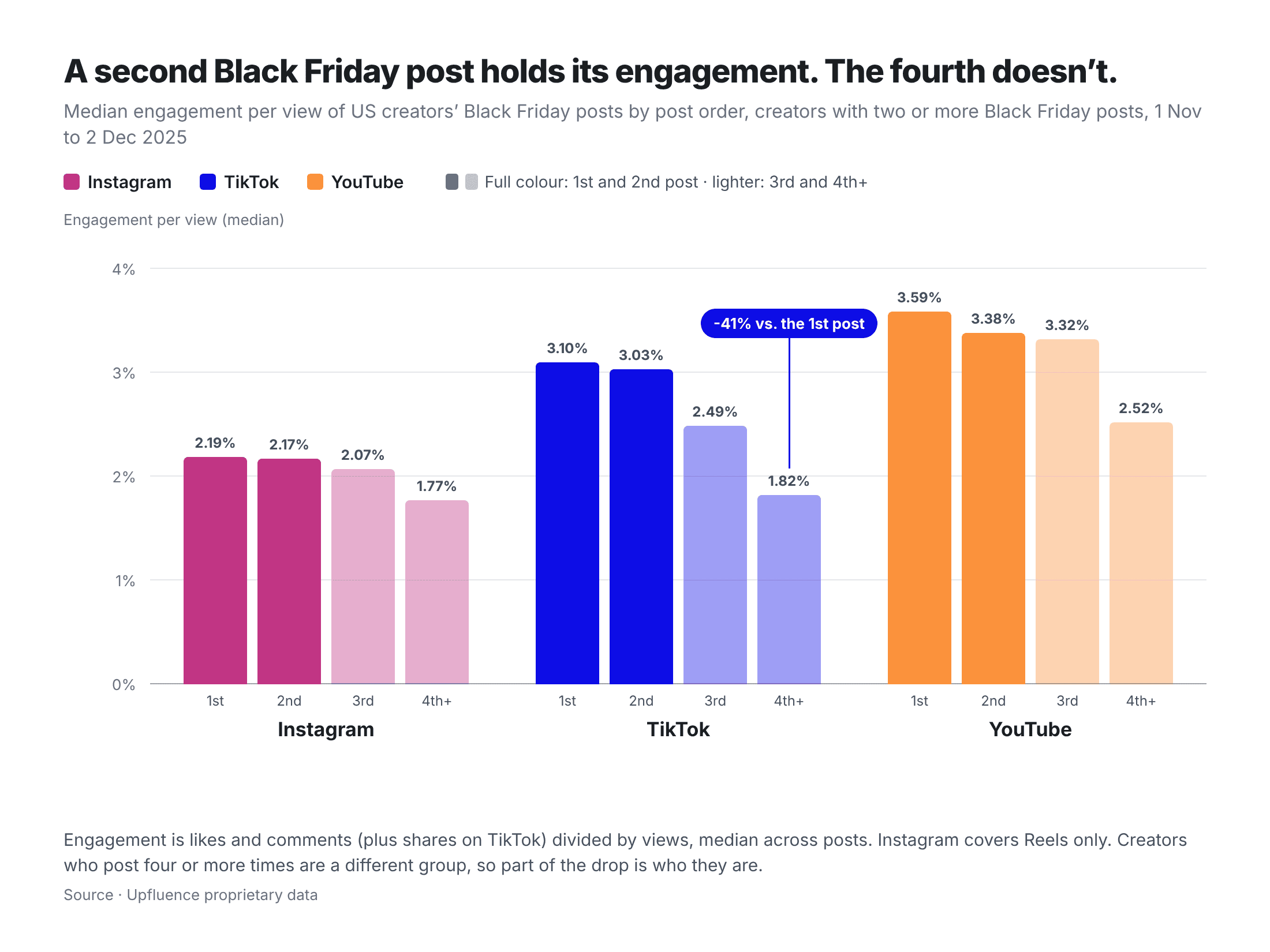
60% of Instagram creators and 48% of TikTok creators who posted about Black Friday last November did it only once. For creators who posted again, the second post kept almost the same engagement per view as the first: 2.2% against 2.2% on Instagram and 3.0% against 3.1% on TikTok.
Engagement dropped from the fourth post on, by 19% to 41% depending on the platform. Part of that comes from who posts that often, but it is a good reason to brief two or three posts per creator, not six.
What goes in the final brief
The final brief should include:
- Final discount codes, affiliate links, or tracking links
- Confirmed sale dates and durations
- Mandatory campaign hashtags, disclosures, or disclaimers
- Any required visual elements (logos, product placement, or unboxing shots)
- Notes on shipping status if products are being sent
On TikTok, add the product’s Shop link to that list. 69.5% of TikTok Black Friday posts worldwide carried a shoppable link in our data study, against 10.9% on Instagram.
Share briefs well in advance and encourage influencers’ creative input: they know what resonates with their followers. Schedule checkpoints for drafts and feedback.
If your campaign involves product seeding, ship this week rather than next. A product that arrives on Black Friday morning is too late to film.
What this means for your team
Put the number of posts and their dates in the contract. One well-timed post per creator is what you get by default.
What should you check in the last two weeks?
Approve content and confirm every posting date. Then check that codes and disclosures are in place, and line up backup creators. These checks happen one to two weeks before Black Friday.
Phase 5: Approvals and last checks (mid-November)
Give every creator a draft deadline at least five days before their posting date, and tell them exactly what you will check. Keep that list short: the code, the dates, the disclosure, and any product claim your legal team needs to see.
Send the final codes and tracking links in one message, so nobody posts with a test code. Verify that product shipments are on track so creators have everything they need to deliver content on time.
Check #ad on every draft
Check the disclosure on every draft. Only 11.5% of Instagram Black Friday posts with a discount code or shopping link carried #ad, #sponsored, or a similar disclosure in the caption last November. On TikTok it was 21%, and on YouTube 36%.
Instagram’s paid partnership label, TikTok’s disclosure setting, and YouTube’s paid promotion label don’t show up in captions, so the true rate is higher than these numbers. Still, a caption disclosure is the one you can check before a post goes live, and the FTC expects it whenever a creator is paid, gifted, or earns commission.
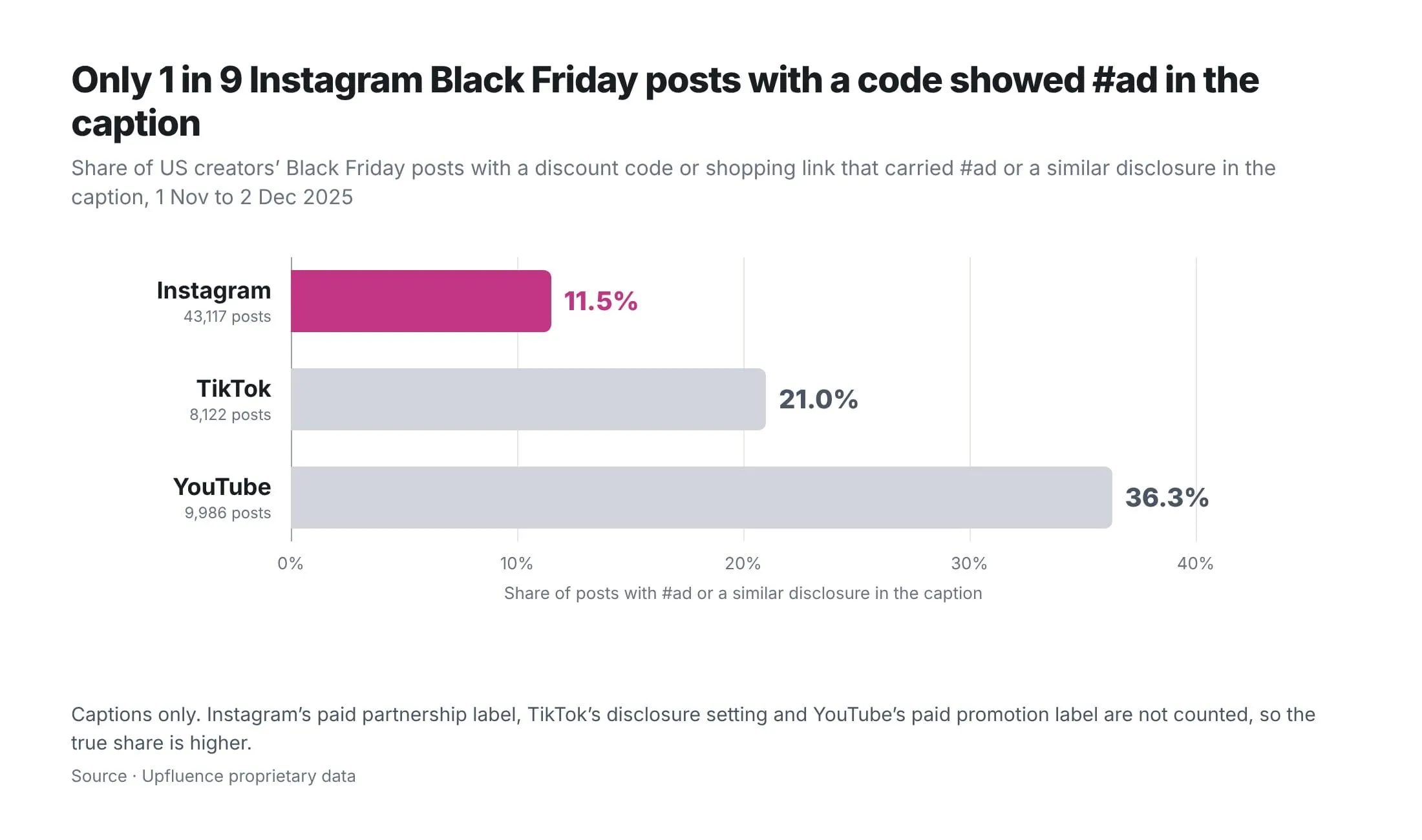
Disclosure is becoming easier to spot. Our data study found the share of Instagram posts with an #ad-style disclosure was 16% higher from January to May 2026 than a year earlier, and 26% higher on YouTube.
This is what the check looks like on a finished post: #ad in the first words, then the brands, the discount, and the creator’s code.
 MI

@mirandaalol
Line up backup creators
Even the best-laid Black Friday campaigns can hit snags: a shipment delay, a miscommunication, or an influencer who can’t deliver on time. Keep reliable backup creators on standby. Past collaborators who delivered solid results can step in if needed.
What this means for your team
Add “#ad in the first line of the caption” to the approval checklist, next to the code and the posting date.
What should happen on Black Friday and after?
Go live on schedule and watch sales by creator every day. Pay creators on time, then run a post-mortem within two weeks of Cyber Monday.
Phase 6: Going live (Black Friday week, late November)
Expect the busiest day to be Black Friday itself. Last season, Instagram Black Friday posts by US creators jumped from about 16,000 on the Wednesday before to about 35,000 on the day, while TikTok stayed between about 11,000 and 16,000 a day from Monday to Saturday.
Thanksgiving was quieter than the Wednesday before it, and volume fell to less than a quarter of Black Friday’s by Cyber Monday. If you want a post to stand out, the days before Black Friday are less crowded than the day itself.
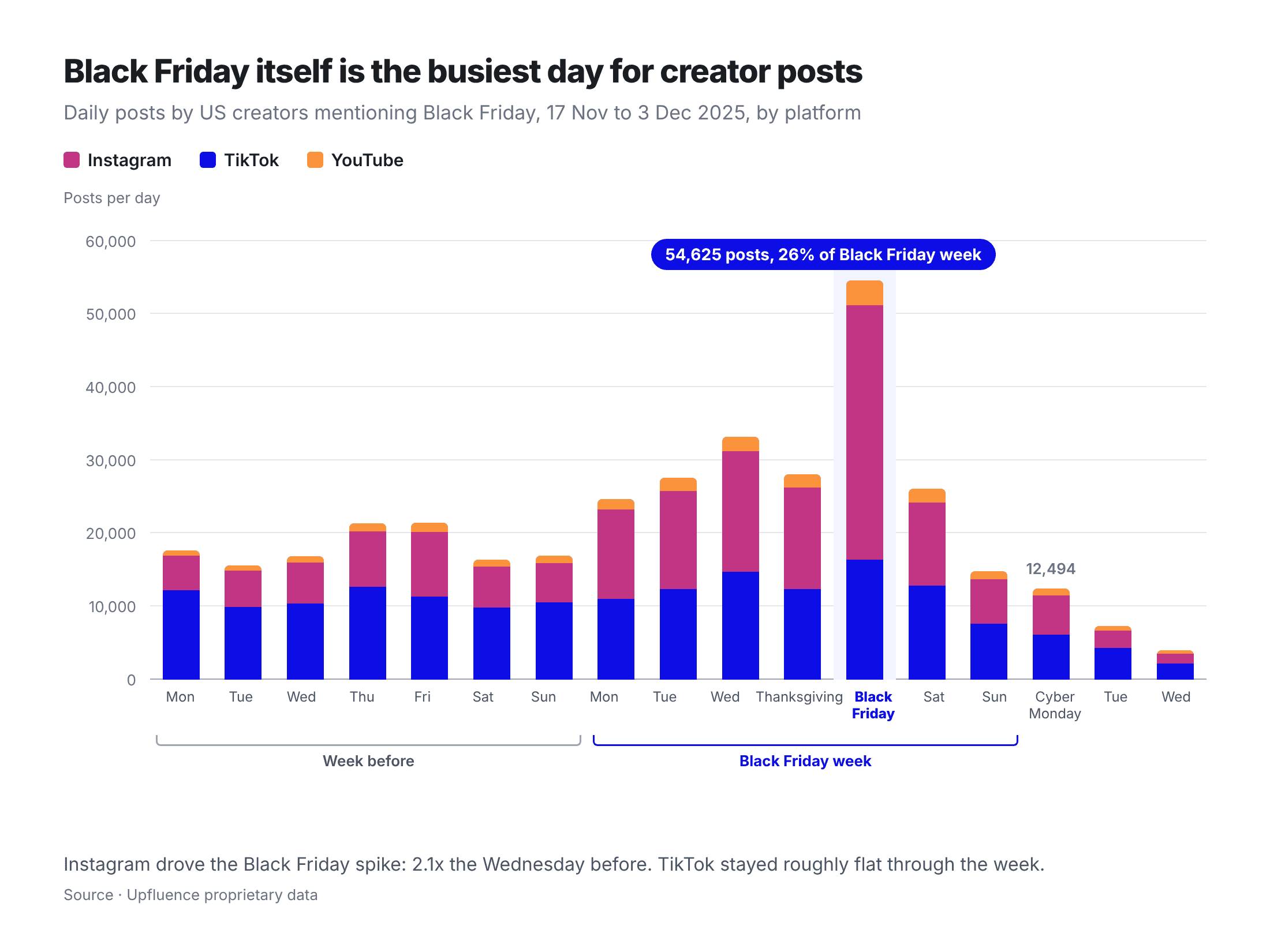
On launch day, verify that all scheduled posts go live on time across the right platforms, with the agreed captions, visuals, and disclosures (#ad, #sponsored). Test discount codes and affiliate links to confirm they work, and check that influencers are using the correct tracking links.
A post that went up on Black Friday morning last season shows the brief working: the sale dates, the code, and the brand’s partner tag are all in the caption.
 CA
@campbellhuntpuckett
When a creator goes quiet on the day, don’t wait. Move their slot to a backup creator, or post the content you prepared yourself.
Pay on the date you promised. A creator paid late in December is a creator who says no next November.
Check sales by creator code every morning of Black Friday week. If a product sells out, tell the creators promoting it that same day and swap in another offer.
Phase 7: The post-mortem (early December)
Go back to the targets you set in Phase 1: sales, CPA, ROAS, and new customers. When you calculate ROI, count every cost, including the product you gifted. Then split the results by creator and by platform.
Rank creators by sales first, then by how easy they were to work with. Write down which formats sold (a haul, an unboxing, a plain deal post) and which posting days worked best.
Ask your top five creators one question each: what would have made this brief easier? Then note what your own team would change, while it is still fresh.
Thank your best performers before Christmas and offer them long-term collaborations: early access to new products, a higher commission, or a place in your spring launch.
For the strategy behind these steps, see our Black Friday marketing strategy guide. For examples of how brands ran theirs last season, read our breakdown of Black Friday campaigns, and for formats to brief, see our Black Friday marketing ideas.
What this means for brands
Sign creators in October, because 58% of US creators’ Black Friday posts last season were live before Black Friday week. Write two or three posts and their dates into each contract. Then check every draft for #ad in the first line, since only 11.5% of Instagram Black Friday posts with a code or shopping link had it in the caption.
Frequently asked questions
When should you start preparing for Black Friday?
Brands should start preparing for Black Friday creator campaigns two to three months ahead, and have creators briefed by early November. 58% of US creators’ Black Friday posts last season went live before Black Friday week, so content planned for the week itself arrives after the conversation has started.
What if you start your Black Friday influencer campaign late?
A late Black Friday influencer campaign should cut scope, not steps. Work with creators you already know and offer one simple code. Send products by express shipping. 60% of Instagram creators posted about Black Friday only once last season, so a few well-briefed posts on the right dates are enough to save a late campaign.
What should you do after Cyber Monday?
After Cyber Monday, review sales by creator and pay every creator on time. Then thank your best performers with an offer for the holiday season. Volume drops fast after the weekend: Cyber Monday drew less than a quarter of Black Friday’s creator posts last season, so the post-mortem can start right away.
How can Upfluence help you run your Black Friday checklist?
Upfluence covers every phase of this checklist in one platform, from finding creators to paying them and tracking their sales.
- Choosing creators: search more than 14 million creator profiles with the Upfluence Search and Find Tool, and filter by audience location, size, and engagement before you shortlist.
- Outreach: send personal emails from your own Gmail or Outlook with AI-powered outreach, and let the follow-ups go out on their own.
- Briefing and approvals: create one code per creator, ship products, and approve drafts in the same place with automated workflows.
- Going live: Upfluence Pay pays creators anywhere in one click and handles the tax forms and invoices.
- Post-mortem: the real-time tracking dashboard shows each creator’s sales as they come in.