

If you’re weighing Grin alternatives, the trigger is usually one of three things: a renewal quote that jumped, support that thinned out as you scaled, or a workflow that still can’t tie a creator’s post to a sale without exporting to a spreadsheet. Grin is a capable creator-management platform for ecommerce, so leaving is rarely about a missing button. It’s about whether the next platform matches how your brand actually makes money.
This guide compares six alternatives, gives each a plain strength, a real trade-off, and the brand model it fits, and then walks through how to move off Grin without losing your creator data.
TL;DR: 6 Best Grin Alternatives
| Platform | Strength | Trade-off | Pricing model | Right for |
|---|---|---|---|---|
| Upfluence | Finds creators already inside your customer and CRM data, then tracks affiliate sales and pays them in one system | Quote-based; onboarding scoped to your program | Subscription, quote-based; no fees on tracked sales | Ecommerce and DTC brands running creator plus affiliate programs |
| Modash | Very large searchable creator database with strong audience analytics | Lighter on outreach-heavy and contract-heavy management | Published self-serve tiers; free trial; enterprise quote-only | Teams that need discovery breadth above all else |
| CreatorIQ | API-verified data, governance, and enterprise reporting depth | More platform and cost than smaller teams need; long onboarding | Sales-led, annual contract, no monthly option | Large programs with governance and multi-brand needs |
| Aspire | Creator marketplace with inbound applications, product seeding, and UGC workflows | No API; meaningful execution still falls to your team | Sales-led quote; annual commitment typical | Brands prioritizing UGC and always-on ambassador programs |
| HypeAuditor | Fraud detection and audience-quality analysis | Narrower campaign and payment tooling than full suites | Free reports plus published paid tiers; enterprise custom | Teams screening creators for audience authenticity |
| Meltwater | Influencer marketing sits inside a full social-listening and PR suite | The broader suite is overhead if you only want creator marketing | Sales-led, custom enterprise quote | Brands already running social listening and PR |
Why Brands Switch from Grin
Brands leave Grin when the platform’s cost or coverage stops matching the program they’re running, not because the product breaks. Four gaps come up most.
- Cost and pricing model. Grin recently moved to a token-based model – a cap on AI/automation usage layered on top of the subscription – which, on an annual commitment, is itself becoming a reason teams shop around. Hitting the usage cap mid-cycle is a real constraint, and some influencer marketing platforms don’t cap AI agent usage at all, so the same work doesn’t meter against you. That’s the one place cost belongs in this decision; the structural comparison is in the sections below, not a headline figure.
- Creator discovery limits. Grin’s roots are relationship management for creators you already know or recruit, and its discovery leans on its own recruitment suite. It has pivoted more recently toward an AI-led discovery model, but teams that need to search a very large open database, or to surface creators hiding inside their own customer list, often want a discovery model built around that from the start.
- Ecommerce and attribution fit. Grin integrates natively with Shopify and WooCommerce and ties activity to sales, which is a genuine strength. The switch usually comes when a brand wants affiliate and promo-code tracking, payments, and revenue attribution to sit in the same workflow without extra tooling or manual reconciliation.
- Support and manual workload. Grin has historically been a fairly manual, relationship-management platform, and as programs scale, the overhead of managing outreach, approvals, and payments across disconnected steps is the pain that pushes a review. Its more recent AI push is aimed at that, but a platform that already automates more of the workflow – influencer marketing automation – is often the actual thing being shopped for, more than any single feature.
Book a demo → Get Started
What to Look for in a Grin Alternative
The right alternative is the one that matches your model, so evaluate on capability groups rather than feature counts. Four groups decide most shortlists.
- Finding creators. Discovery splits into two questions: how wide is the open database and how precise are the filters, and – the one most tools skip – can the platform find creators already inside your customer and CRM data. A brand with an engaged customer base gets more from customer-to-creator matching than from raw database size, because those creators already buy from you and convert warmer.
- Managing and paying creators. This is where creator relationship management earns its keep: contact history, partnership stages, custom views, and a clean handoff into payments. Weigh global payout coverage, tax documentation, and how many manual steps sit between “approved” and “paid.”
- AI capabilities and workflow automation. AI has become a real evaluation axis, not a novelty line. Judge it on function, not label: does it recommend well-fit creators, automate outreach at scale, optimize live campaigns, and surface data insights you’d otherwise dig for by hand. The test is how many hours it removes from setup and coordination.
- Revenue attribution. If you want measurable sales, pick a platform that attributes revenue to each creator and connects to your store, not one that reports reach alone. Affiliate and promo-code tracking, sales attribution, and clean export are what let you defend the channel to a finance team.
Before you compare vendors on price, run this checklist against each one:
- Creator discovery depth – database size, platform coverage, and filter precision
- Customer-to-creator matching – surfacing creators already in your customer and CRM data
- Creator relationship management – contact history, partnership stages, and custom views
- AI and workflow automation – creator recommendations, outreach automation, campaign optimization, and data insights
- Affiliate and promo-code tracking – link generation and commission automation
- UGC and content rights – collection, approval, and paid-usage permissions
- Reporting and ROI attribution – sales attribution and export options
- Payments – global payouts, tax documentation, and available methods
- Integrations – your ecommerce platform, CMS, and payment stack
- Contract terms – commitment length, seat minimums, and upgrade triggers
6 Best Alternatives to Grin for Influencer Marketing
Each platform below gets a strength, a real trade-off, and the brand model it fits. Confirm current features against each vendor’s live page before you commit.
1. Upfluence
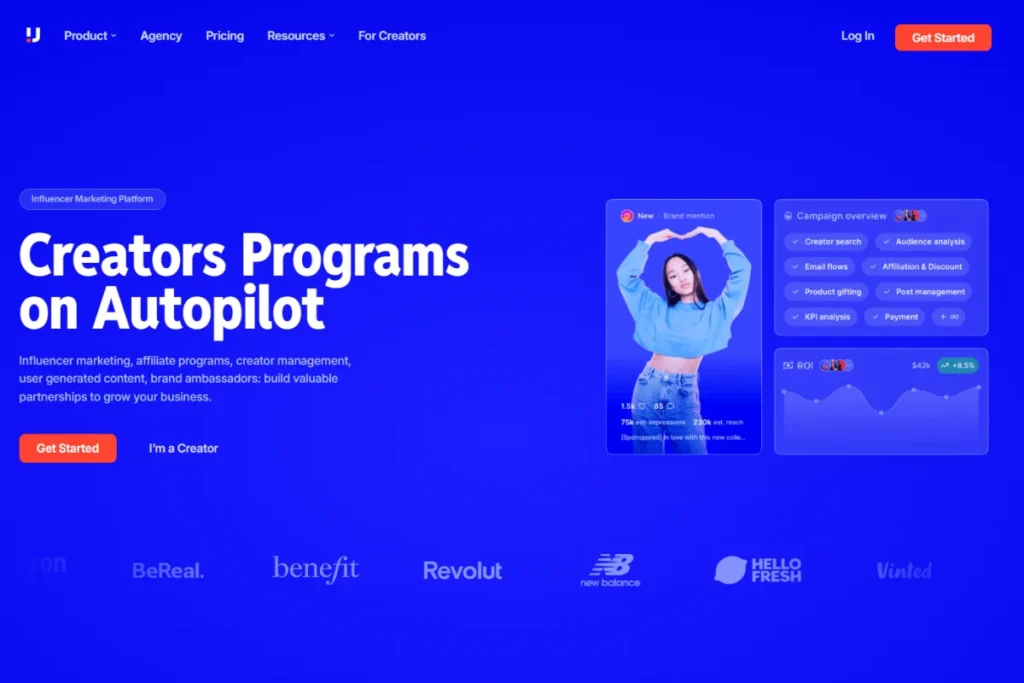
Upfluence is an end-to-end creator and affiliate marketing platform for ecommerce and DTC brands. Its standout is the AI agent. Upfluence AI (Jaice) doesn’t only recommend well-fit creators and automate outreach, it can run campaigns, vet creators, and report on performance, so a small team operates a much larger program.
Underneath that sits customer-to-creator discovery: Live Capture identifies creators and influential customers already sitting in your customer list, mailing list, and store data across Shopify, WooCommerce, Magento, BigCommerce, and Amazon. Those creators already buy from you, and Upfluence’s own data puts them 7x more likely to accept a partnership, a warmer starting point than cold database outreach.
From there, the workflow stays in one place: outreach, creator relationship management is native, and affiliate program tracking with promo-code generation and commission automation connects creator activity to revenue, ROI, and AOV. Upfluence Pay handles global payouts, KYC, and tax forms, and takes no percentage on tracked sales. Upfluence AI (Jaice) recommends well-fit creators and automates outreach so a small team can run a larger program. For brands that treat creators as a measurable revenue channel, that combination of ecommerce influencer marketing discovery and built-in attribution is the core reason it lands on Grin shortlists.
It’s the right call when your program spans both content and performance, and you want discovery, affiliate tracking, and payments in one system rather than stitched together.
Find creators inside your own customer data → Get Started
2. Modash
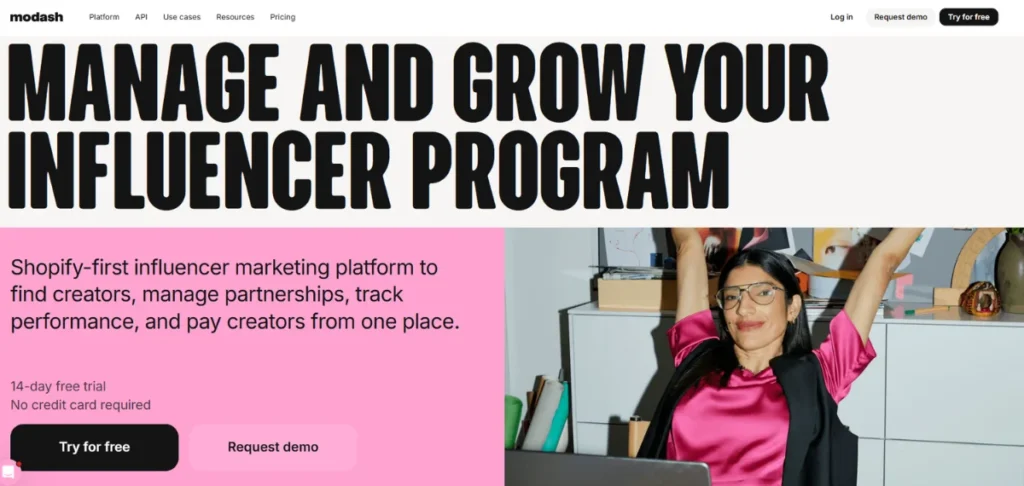
Modash is a discovery-first platform built around a very large searchable creator database across Instagram, TikTok, and YouTube, with strong audience analytics and a native Shopify integration. Its stand-out is transparency and reach: published self-serve tiers and a free trial mean you can budget and start searching the same day, without a sales call.
The trade-off is depth on the rest of the workflow. Modash is lighter on outreach-heavy and contract-heavy management than a full CRM-style suite, so teams that need deep relationship and approval workflows tend to pair it with other tools. It fits teams whose first priority is finding and vetting creators at scale, with campaign management a secondary need.
3. CreatorIQ
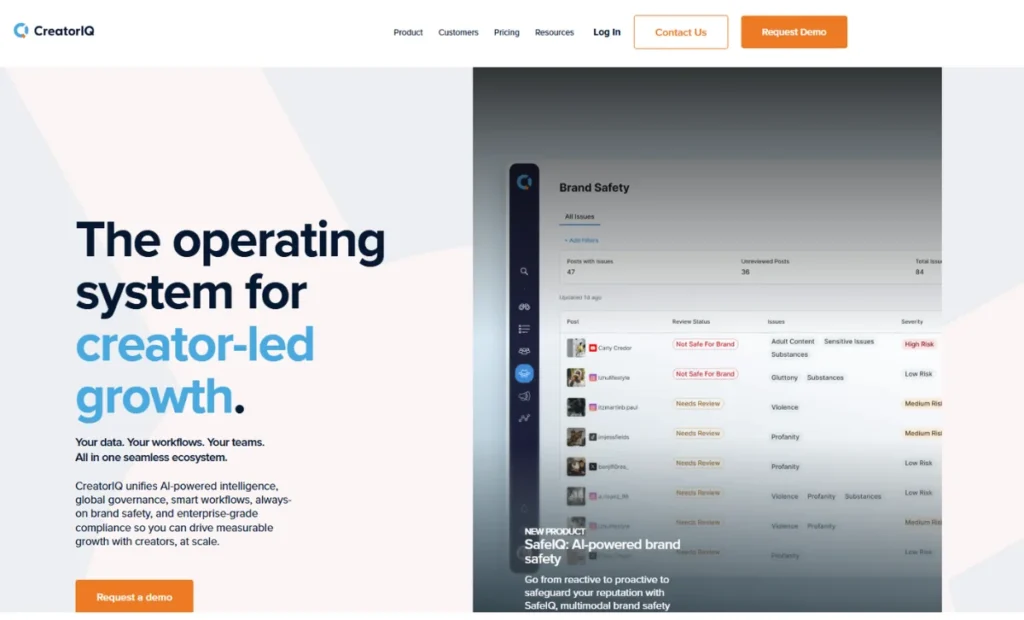
CreatorIQ is an enterprise creator-marketing platform aimed at large brands and global agencies. Its edge is data quality and governance: direct social-platform API integrations rather than scraped data, fraud signals, earned-media measurement, multi-brand governance, and best-in-class reporting for teams running many programs at once.
That depth is also the trade-off. Pricing is sales-led on an annual contract with no monthly option and no cheap starter tier, and onboarding runs weeks, so smaller teams often find it’s more platform and more commitment than the program needs. It fits large, ongoing programs with the headcount and governance requirements to use the full weight of the tool.
4. Aspire
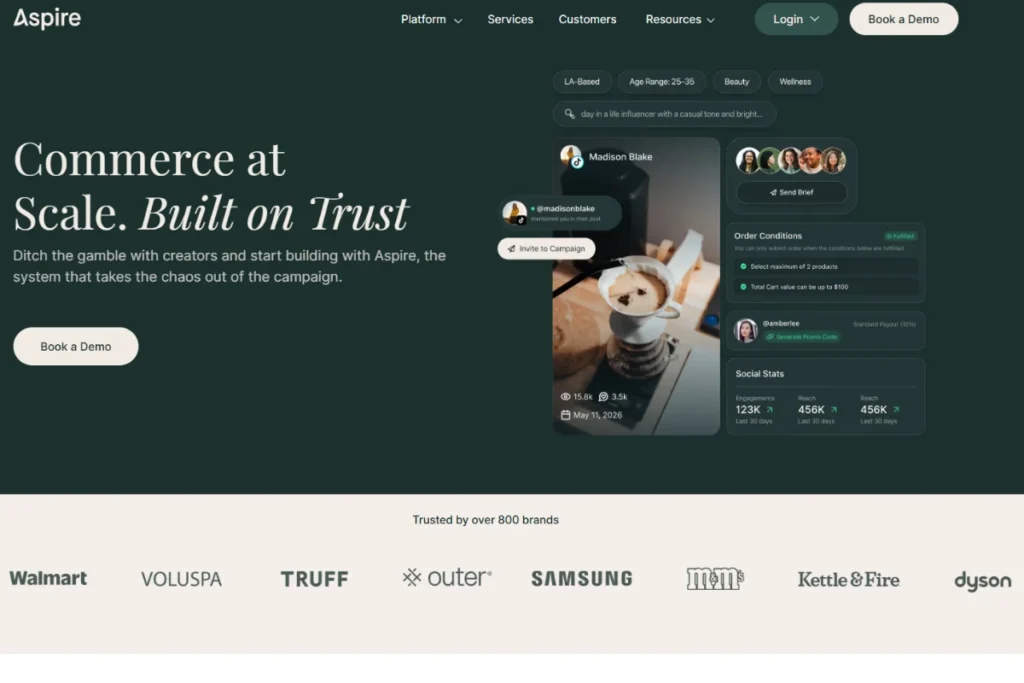
Aspire is an influencer marketing platform strong on inbound creator discovery: its Creator Marketplace lets influencers apply to your campaigns, and it layers in product seeding, contracts, content review, UGC workflows, and content repurposing for paid ads. For brands building always-on ambassador and affiliate programs alongside sponsored content, that marketplace-plus-seeding combination is the draw.
The trade-off is that pricing is quote-based with an annual commitment typical, there’s no API for custom integrations, and meaningful campaign execution still falls to your team. It fits content-led ecommerce brands that want a steady inbound stream of creators and UGC more than a hands-off, fully automated pipeline.
5. HypeAuditor
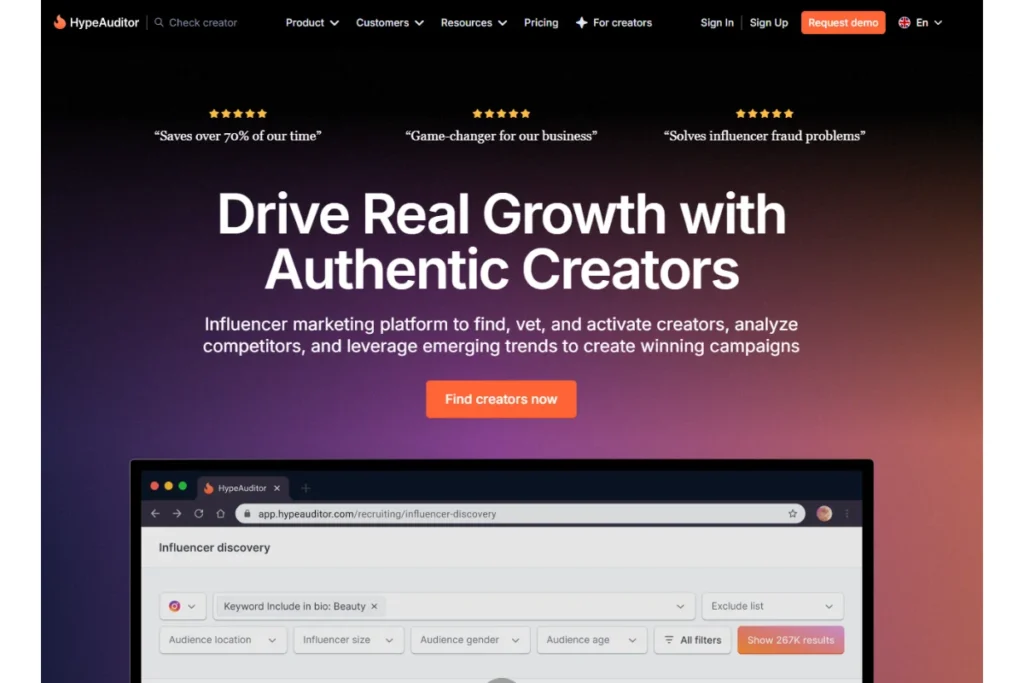
HypeAuditor started as a fraud-detection and audience-quality tool and expanded into discovery, analytics, outreach, and campaign management. Its enduring strength is the thing it was built for: screening creators for fake followers and audience authenticity, with free basic reports and published paid tiers that make it easy to test.
The trade-off is a narrower campaign and payment tooling than a full end-to-end suite, so it often pairs with a management platform rather than replacing one. It fits teams whose main worry is influencer fraud and audience quality, and who want authoritative vetting data before they commit budget.
6. Meltwater
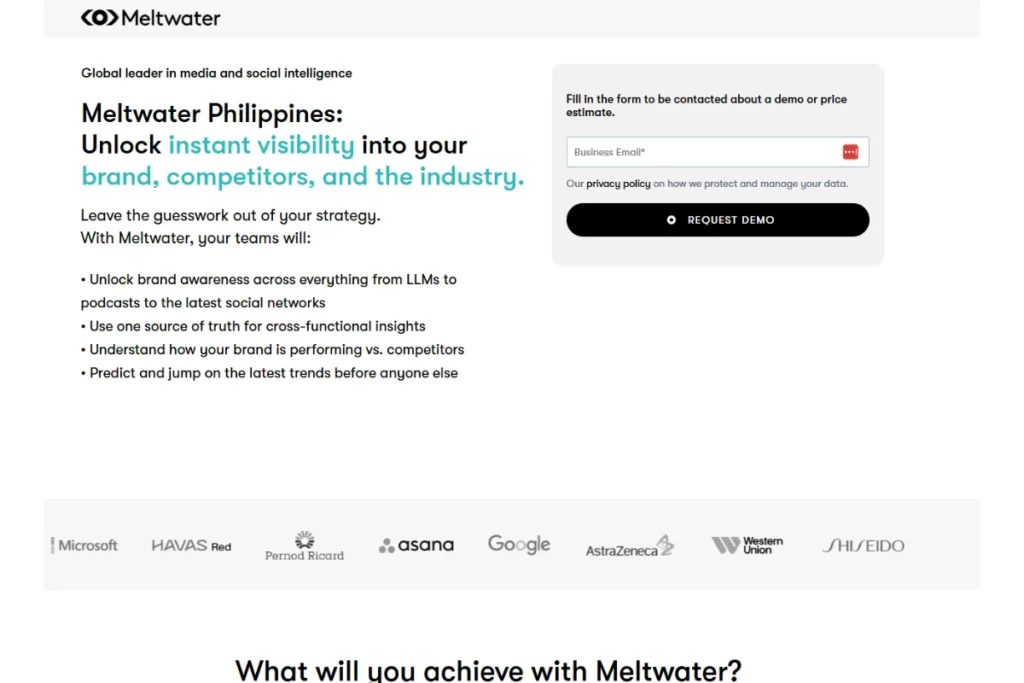
Meltwater folds influencer marketing into a broader media-monitoring, PR, and social-listening suite (its influencer product line is Klear). Creators are treated as an extension of earned media, so you can coordinate journalist outreach and creator partnerships from one system and see how influencer content amplifies press coverage in unified reporting.
The trade-off is scope: pricing is sales-led and custom, and the wider suite is overhead if creator marketing is all you actually need. It fits PR and communications teams already running social listening who want to add influencer campaigns to an existing earned-media practice, rather than ecommerce teams optimizing for creator-driven sales.
How to Choose the Right Grin Alternative for Your Brand
The shortlist narrows fast once you weigh the criteria your model actually depends on and set the rest aside.
- Early-stage DTC. With transparent, self-serve pricing and discovery, you can start without a sales cycle; set aside enterprise governance and multi-brand tooling you won’t use yet. A published-tier discovery platform lets you pilot before you commit budget.
- Scaling ecommerce with an affiliate focus. Weight customer-to-creator matching, affiliate and promo-code tracking, and revenue attribution in one workflow; set aside heavy social-listening features. This is where consolidating discovery, tracking, and payments removes the most manual overhead.
- Content-led brands. Weight UGC collection, content rights, a creator marketplace, and repurposing into paid ads; set aside deep API and BI integration if you’re not running custom data pipelines. Inbound creator flow matters more than raw database size here.
- Enterprise. Weight governance, API-verified data, multi-brand controls, compliance, and reporting depth; accept longer onboarding and annual commitment as the cost of that rigor.
- A decision path you can run in one sitting. Start with your primary job – discovery, execution, or attribution. If it’s discovery, favor published-tier database tools you can trial. If it’s execution and revenue, favor an end-to-end platform that ties creators to sales and payments. If it’s vetting or earned media, favor the specialist. Then check pricing posture against your ability to commit: can you pilot first, or are you signing an annual contract on a quote? How platform pricing actually works is the last gate, because the structure – not a headline number – is what determines your real cost at your program’s size.
See a plan scoped to your program → Get Started
How to Switch from Grin Without Losing Creator Data
A mid-contract move is mostly a data and workflow problem, not a software problem. Run it in four steps, and expect a few weeks of overlap rather than a clean overnight cutover.
Audit Your Active Campaigns and Creator Roster
Before you export anything, inventory what’s live: every active partnership, its stage, the creators you want to keep, and any commitments that outlast your Grin contract. This is the map you’ll rebuild against, and it’s easier to make while you still have full access to the current platform.
Export Creator Data and Performance History
Export your creator lists, contact details, and performance history early, because export access often gets harder once you’ve given notice. Contact records, tags, and list structure usually move cleanly as CSVs. What rarely transfers intact is historical performance tied to the old platform’s tracking and any in-platform message history, so decide what you need to preserve manually before you cut over.
Rebuild Campaign Workflows in the New Platform
Map your existing stages, approvals, and integrations into the new tool, then connect your store, CMS, and payment stack. Campaign management workflows and payment setup are the pieces to get right first, since they’re what your team touches daily. Rebuild rather than force a one-to-one copy – a switch is the moment to drop steps you only kept because the old tool required them.
Run a Pilot Campaign Before Full Cutover
Run one small campaign end-to-end before you move everything, and use it to validate the part that matters most: tracking and attribution. If clicks, conversions, and payouts reconcile against your store on a pilot, you can scale the migration with confidence. If they don’t, you’ve found the gap while it’s cheap to fix.

Frequently Asked Questions (FAQs)
What Is Grin Used For?
Grin is a creator-management platform that brands use to discover, recruit, and manage influencer relationships at scale, with native Shopify and WooCommerce integrations that tie creator activity to sales. It combines relationship management, campaign tracking, product seeding, and payments in one system, aimed mainly at established ecommerce and DTC brands running structured programs.
What Is the Difference Between an Influencer Marketing Platform and a Creator Marketplace?
An influencer marketing platform is software your team drives to find creators, run campaigns, track results, and pay creators. A creator marketplace is a place where creators discover your campaigns and apply inbound, so recruitment comes to you. The distinction changes your shortlist: if you want a steady inbound stream of applicants, a marketplace model matters; if you want to search and target creators yourself, prioritise discovery depth and filters. Some platforms, Upfluence included, offer both.
Can Agencies Use a Grin Alternative to Manage Multiple Clients?
Yes. The features that matter for agencies are multi-client workspaces, per-client permissions, and clean client-facing reporting so data doesn’t leak between accounts. Enterprise-tier platforms build this in as governance; check that separation and white-label reporting are supported at the tier you’d actually buy.
Can You Run Two Influencer Marketing Platforms Side by Side?
You can, and brands often do during a migration or when pairing a specialist vetting tool with a management platform. The risk is duplicate tracking: if two systems both attribute the same sale, your ROI numbers double-count. Run parallel tools with clear ownership of each function, and make sure only one system is the source of truth for attribution.
Conclusion
The right Grin alternative depends on your model, your budget, and how tightly creator activity has to connect to revenue. Discovery-first teams, enterprise programs, content-led brands, and PR-led ones each have a better-fit answer above, so match the platform to the job you’re actually hiring it for.
For ecommerce and DTC brands that want creator discovery, affiliate tracking, and payments in one system – with the option to find creators already inside your customer data – Upfluence covers the full workflow rather than one slice of it. The next step is a plan scoped to your program and a look at the migration path from where you are now.
Start your switch → Get Started