

Aspire.io is a capable marketplace and community platform, so brands rarely leave over a broken feature. They leave over how it’s built. Aspire supports mainly Shopify on the commerce side and Klaviyo for CRM, while its payments lean on PayPal, so brands running a wider stack, or paying an international roster, hit its edges quickly. It’s also marketplace-first: inbound applications are strong, but they don’t always match a specific niche, which is exactly where outbound discovery and automated outreach do more of the work. And most of the platform is still run by hand, there’s no AI agent to take the repetitive tasks off your team.
This guide compares five alternatives, weighs them on the differences that actually decide the pick, commerce, and integration breadth, how payouts work, discovery model, and how much the platform automates, and shows where each one fits.
TL;DR: Top 5 Aspire Alternatives Ranked
| Platform | Standout | Trade-off | Pricing model | Fits |
|---|---|---|---|---|
| Aspire (benchmark) | Creator marketplace with inbound applications and UGC workflows | Execution stays manual as programs scale | Sales-led quote, annual commitment | Community and ambassador programs |
| Upfluence | Native affiliate and ecommerce attribution, plus customer-to-creator discovery | Quote-based; onboarding scoped to your program | Subscription, quote-based; no fees on tracked sales | Ecommerce and DTC brands tying creators to revenue |
| Grin | Deep creator relationship management for DTC ecommerce | Enterprise posture; annual commitment, no free trial | Sales-led quote, annual | Established DTC ecommerce programs |
| CreatorIQ | Governance, API-verified data, and enterprise reporting | More platform and cost than smaller teams need | Sales-led, annual, no monthly option | Large, multi-brand enterprise programs |
| Modash | Large discovery database with published, self-serve pricing | Lighter on outreach- and contract-heavy management | Published tiers + free trial; enterprise quote-only | Lower-commitment discovery |
| Later Influence | Influencer program inside a social-scheduling and creator-commerce suite | Opted-in index narrows the pool; sales-led pricing | Sales-led quote, no published tiers | Social-first, content-led programs |
The Biggest Tradeoffs Brands Face With Aspire
Brands review Aspire when the platform model stops matching the program, not because the product fails. Three tradeoffs come up most, and each maps to a different alternative below.
- Manual execution, not an AI agent: Aspire didn’t move with the curve on AI agents and autonomous execution, so day-to-day running, outreach, follow-up, coordination, still lands on your team. Compared with a platform that has an agent taking those tasks over, the workflow can feel like it’s stuck several years back. If cutting manual hours is your first constraint, that gap is the one to weigh.
- Marketplace-heavy, light on outbound discovery: Aspire’s center of gravity is its Creator Marketplace and inbound applications, not searching for and reaching out to specific creators. Inbound is great for volume, but it doesn’t always surface the niche fit a campaign needs. Brands that want to actively find and target creators, then automate the outreach, look for a discovery-first model instead of waiting for applicants.
- Limited integrations: Aspire mainly supports Shopify for commerce and Klaviyo for CRM, and there’s no API or MCP for custom setups. A platform that connects across more of your stack and exposes an API fits a wider range of tech environments than a Shopify-plus-Klaviyo footprint.
Book a demo → Get Started
Top 5 Aspire Alternatives for Ecommerce Creator Programs
Each platform below gets its standout, the Aspire pain it addresses, and the model it fits. Read them against the two axes – how long you can commit, and whether attribution or reach leads. Confirm current features on each vendor’s live page before you commit.
1. Upfluence
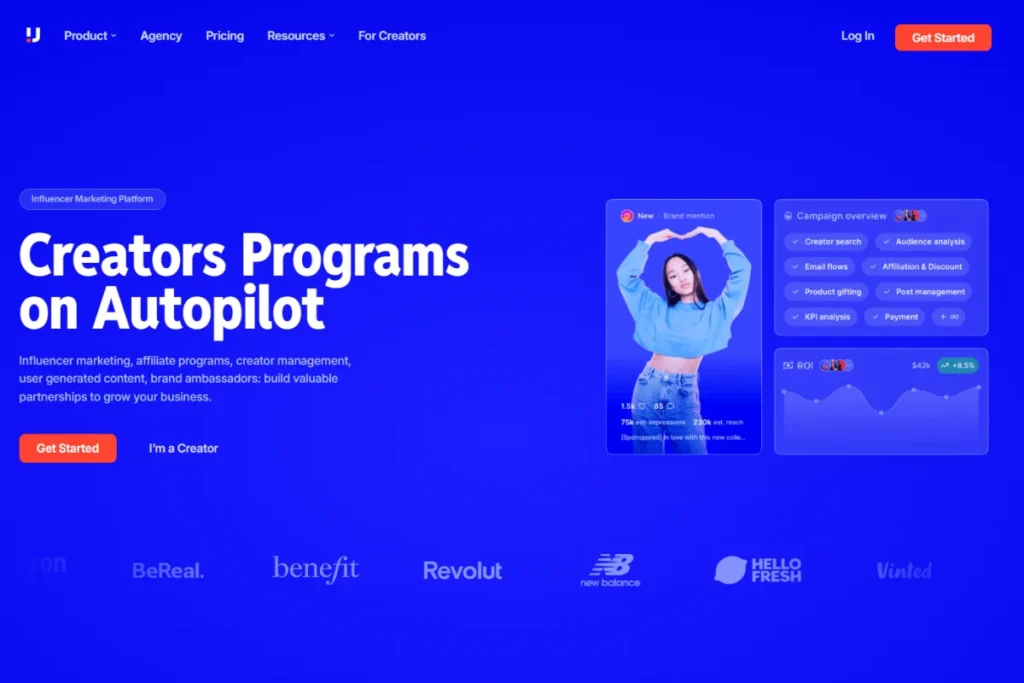
Upfluence is an end-to-end creator and affiliate marketing platform for ecommerce and DTC brands, and it addresses the Aspire tradeoff most directly on attribution.
The first difference is the AI agent. Upfluence AI (Jaice) recommends well-fit creators and automates outreach, so a small team can run a larger program instead of doing every step by hand, the automation layer Aspire’s manual workflow doesn’t have.
The second is discovery. It isn’t only an open database search — Live Capture surfaces creators and influential customers already inside your customer list and stores data, and those existing customers are, by Upfluence’s own data, 7x more likely to accept a partnership.
Where a marketplace program can leave you reporting reach, Upfluence connects creator activity to revenue: native promo-code and affiliate tracking, sales attribution, and ROI, AOV, and commissions per creator across Shopify, Amazon, WooCommerce, BigCommerce, and Magento. That ecommerce influencer marketing attribution is the core reason it lands on Aspire shortlists.
Two more differences matter against Aspire. Discovery isn’t only an open database search – Live Capture surfaces creators and influential customers already inside your customer list and stores data, and those existing customers are, by Upfluence’s own data, 7x more likely to accept a partnership. And the workflow stays in one system: discovery, creator relationship management, outreach with Upfluence AI (Jaice) recommending and automating, and Upfluence Pay handling global payouts, KYC, and tax forms with no percentage taken on tracked sales.
This suits ecommerce and DTC brands that treat creators as a measurable revenue channel and want discovery, affiliate tracking, and payments in one place. For the direct head-to-head that searchers keep asking for, Upfluence and Aspire compared lays out the differences feature by feature.
Tie creators to tracked revenue → Get Started
2. Grin
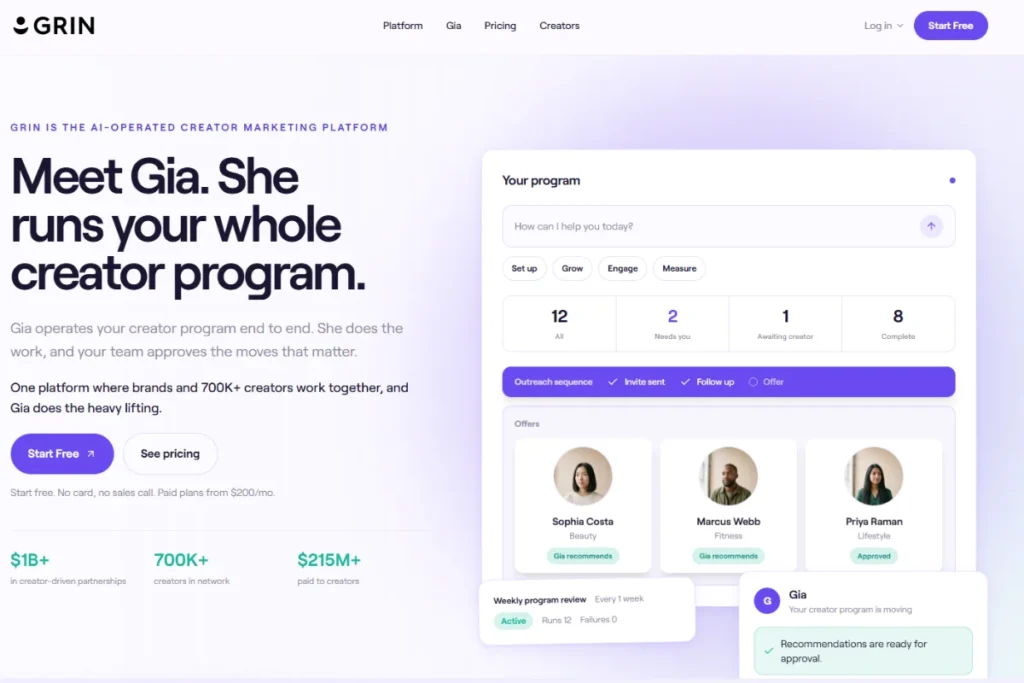
Grin is a creator management platform built for DTC ecommerce, with deep relationship management, native Shopify and WooCommerce integrations, product seeding, and payments that tie creator activity to sales. Against Aspire, its draw is CRM depth for brands running structured, always-on programs.
The tradeoff is commitment. Grin is sold on annual, quote-based contracts with no free trial and an enterprise posture, so it trades Aspire’s lock-in for a similar one rather than removing it. Reach for it when your program is established, DTC, and relationship-heavy, and contract flexibility is not your first concern.
3. CreatorIQ
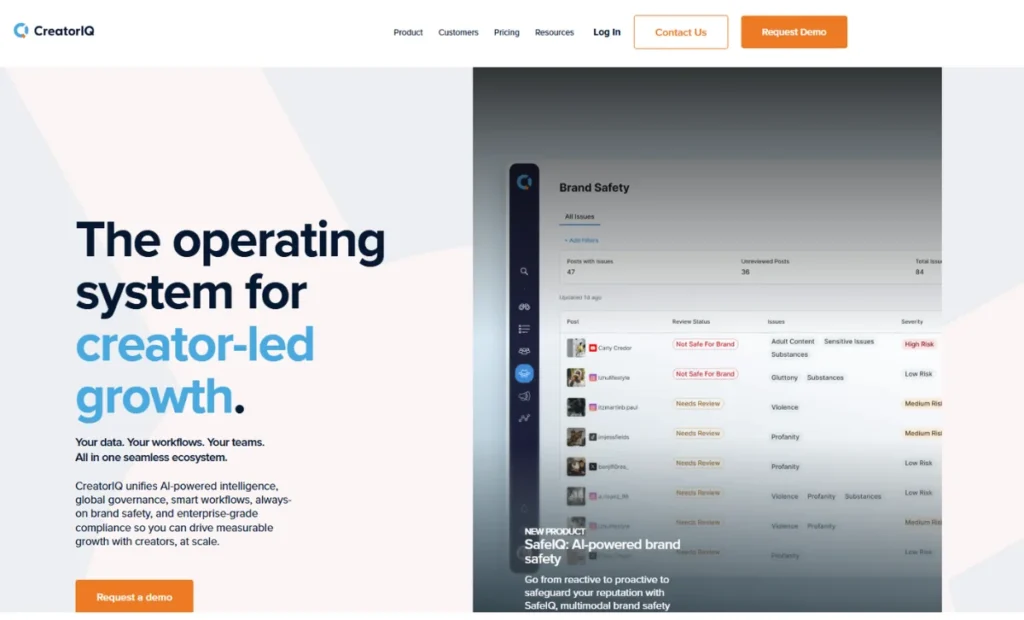
CreatorIQ is an enterprise creator-marketing platform whose strength is governance and data rigor: direct social-platform API integrations rather than scraped data, fraud signals, earned-media measurement, multi-brand controls, and enterprise-grade reporting. For large teams managing many programs, that depth outclasses a marketplace tool.
That depth is also the tradeoff. Pricing is sales-led on an annual contract with no monthly option or starter tier, and onboarding runs for weeks. The fit is large, ongoing, multi-brand programs with the headcount to use the full platform – not a leaner team that would feel the weight without needing it.
4. Modash
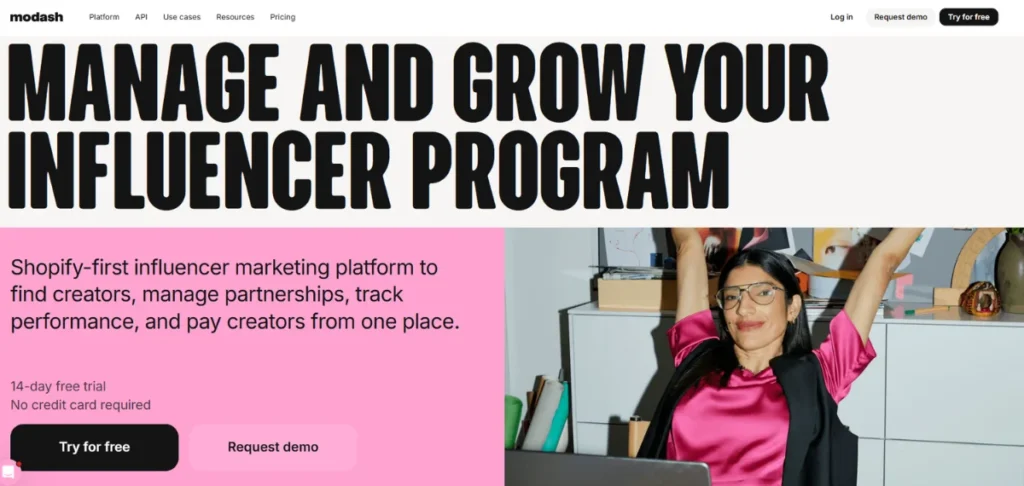
Modash is the answer to Aspire’s contract lock-in specifically. It’s a discovery-first platform with a very large creator database across Instagram, TikTok, and YouTube, strong audience analytics, and a native Shopify integration – and, unlike the enterprise tools here, published self-serve tiers with a free trial, so you can budget and start the same day without a sales call.
The tradeoff is depth on everything past discovery. Modash is lighter on outreach- and contract-heavy management, so teams that need deep relationship workflows tend to pair it with another tool. The fit is a lower-commitment program whose first priority is finding and vetting creators, with management a secondary need.
5. Later Influence
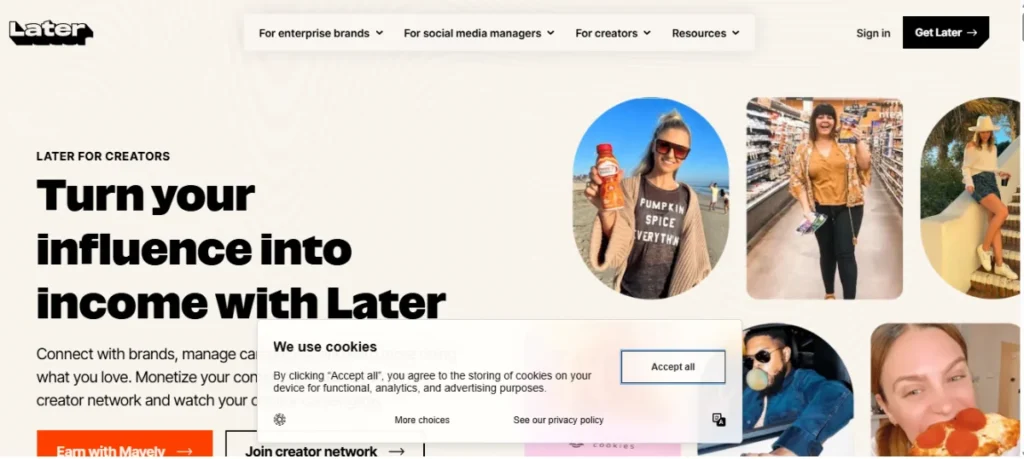
Later Influence, formerly Mavrck, is now the influencer arm of Later’s wider suite, sitting alongside social scheduling and, since the Mavely acquisition, creator commerce. Against Aspire, its distinction is that content and community workflows connect to social publishing, and its index is opted-in rather than scraped, which favors authenticity.
The tradeoffs are the flip side of both: the opted-in index narrows the available pool, and pricing is sales-led with no published tiers, so the commitment question mirrors Aspire’s. The fit is social-first, content-led programs – especially teams that already want scheduling, influencer, and commerce under one roof.
Which Aspire Alternative Matches Your Growth Stage?
Run the two axes against your stage and the shortlist collapses to one or two names.
- Early or first-program teams. Your binding constraint is commitment, not governance. Weight published, self-serve pricing, and discovery you can start without a sales cycle; set aside enterprise reporting and multi-brand controls you won’t use yet. A platform you can trial before you buy is worth more than one with a longer feature list.
- Scaling DTC and ecommerce. Your binding constraint is attribution. Weight customer-to-creator discovery, affiliate and promo-code tracking, and revenue attribution in one workflow, so creator activity shows up as sales you can defend. This is the stage where consolidating discovery, tracking, and payments removes the most manual work, and where scaling an influencer search platform with the rest of the stack matters more than raw database size.
- Enterprise creator teams. Your binding constraints are governance and measurement. Weight API-verified data, multi-brand controls, compliance, and reporting depth; accept longer onboarding and annual commitment as the cost of that rigor. Reach and attribution both matter here, but standardized cross-market measurement usually leads.
The one-sitting decision is to name your first constraint – automation, attribution, or governance. Automation points to a platform with an AI agent that takes over the manual work. Attribution points to an end-to-end platform that ties creators to sales.
Governance points to enterprise tooling. From there, how platform pricing works is the tiebreaker, because structure – not a headline number – sets your real cost at your program’s size.
See a plan scoped to your program → Get Started
Common Mistakes to Avoid When Moving From Aspire
Most switch pain is self-inflicted and preventable. Five mistakes cause the majority of it.
- Exporting too late. Pull your creator lists, contacts, and performance history while you still have full access, not after you’ve given notice – export access tends to narrow once you do.
- Assuming everything transfers. Contact records and tags usually move as CSVs; historical performance tied to the old platform’s tracking and in-app message history often don’t. Decide what to preserve manually before cutover.
- Copying the old workflow one-to-one. A switch is the moment to drop steps you only kept because Aspire required them. Rebuild the workflow around how you actually work now.
- Reconnecting integrations last. Your store, CMS, and payment stack are what the team touches daily. Set those up first, then validate that tracking reconciles against your store before you scale.
- Skipping the AI-and-automation check. Platforms differ widely in what their automation actually does. Evaluate whether it recommends well-fit creators and removes real hours from setup and outreach, rather than taking the feature name at face value.
You don’t have to run the move alone. Upfluence has a dedicated onboarding team that helps map your existing programs across and get tracking reconciled, so the transition is guided rather than DIY.
Keep the old platform running in parallel through one pilot campaign, and only cut over once attribution reconciles. A few weeks of overlap is cheaper than a quarter of broken reporting.
What Makes Upfluence Different
Upfluence puts discovery, creator management, affiliate tracking, and ecommerce attribution in one workflow, which is the practical answer to the two tradeoffs that push brands off a marketplace model: reporting that stops at reach, and programs that fragment across tools as they scale.
The first differentiator is the AI agent. Upfluence AI (Jaice) recommends well-fit creators and automates outreach so a lean team runs a program that would otherwise need more hands, the layer a manual, marketplace-first platform doesn’t have.
The second is that creator activity connects to tracked revenue by default. Influencer analytics tie clicks, conversions, promo codes, and affiliate links to revenue, ROI, AOV, and per-creator commissions, and Live Capture lets you recruit creators already inside your customer data instead of only searching an open database. The ideal fit is a brand tying creators to tracked revenue across Shopify, Amazon, and WooCommerce, where proving the channel to a finance team matters as much as running it.

Frequently Asked Questions (FAQs)
Is Aspire the Same as AspireIQ?
Yes. Aspire.io was formerly branded AspireIQ, and it’s the creator marketing platform for ecommerce brands – not Aspire the neobank or Vectric Aspire the CNC software, which share the name but are unrelated. When comparisons reference AspireIQ, they mean the same platform discussed here.
Does Aspire Integrate with Shopify and Other Ecommerce Platforms?
Yes. Aspire offers a native Shopify integration (available through the Shopify App Store) that lets brands send products, track sales, and pay commissions from within the platform, and it connects to other major ecommerce systems. Its platform coverage centers on Instagram, TikTok, YouTube, and Pinterest for creator campaigns.
Can You Export Your Creator Data When Leaving Aspire?
Brands can typically export core records – creator lists, contacts, and campaign data – usually as CSV files. Data portability matters because what exports cleanly (contacts, tags) and what often doesn’t (historical performance tied to the old platform’s tracking, in-app message history) determines how much of your program history you keep. Export early, while you still have full account access.
Does Aspire Support Affiliate Marketing and Revenue Attribution?
Aspire supports affiliate and ambassador programs, including link and commission workflows. It’s worth separating two things buyers often merge: affiliate management (running the program) is not the same as revenue attribution (tying each sale back to a specific creator through your store to report ROI per creator). If per-creator attribution is a priority, confirm how deeply a platform connects to your store, not just whether it runs affiliate links.
What Should Brands Check Before Signing an Influencer Marketing Platform Contract?
Check five things before you sign: the pricing structure and whether you can start small, the contract length and renewal terms, seat and usage minimums and what triggers an upgrade, data ownership and export rights, and the integrations that connect the platform to your store and payment stack. In this category, contract flexibility and data portability are where the real differences hide.
Conclusion
The right Aspire alternative comes down to two questions: how long you can commit, and whether revenue attribution or reach reporting leads. Early teams that need flexibility point toward published-tier discovery; enterprises point toward governance-grade tooling; and scaling ecommerce brands that need creators tied to tracked sales point toward an end-to-end platform.
For that last group – ecommerce and DTC teams that want discovery, management, and tracked revenue in one workflow, with the option to recruit creators already in their customer data – Upfluence is built around the attribution the marketplace model tends to leave out. The next step is a plan scoped to your program.
Try Upfluence for creator discovery, management, and tracked revenue.