
Automated influencer outreach tools exist because the manual version quietly eats your week. You copy a template, swap in a name, tweak a line, hit send, then repeat it two hundred times, and most of those emails still read like a copy-paste blast a creator will ignore. You can send mass outreach by hand, and plenty of teams do, but volume alone does not earn replies, which is why personalization at scale is the lever that actually moves your reply rate.
The harder problem starts after the reply lands. Once creators write back, the work shifts to negotiation, content approval, and follow-ups, and running that across 50 or more creators can turn into a full-time job on its own. Automated outreach is built to handle all three stages, the first message, the follow-up, and the reply, so the volume never outruns your ability to manage it.
We compare five tools by how they actually automate, then walk through automating a sequence without flattening the personalization that gets replies. This guide is for marketers and ecommerce teams who already run outreach and want to stop trading their afternoons for a low reply rate.
TL;DR - 5 Best Automated Influencer Outreach Tools
| Tool | Best for | Standout automation feature |
|---|---|---|
| Upfluence | Ecommerce and affiliate programs | AI email sequences sent from your own Gmail or Outlook |
| Modash | Discovery-led outreach | AI creator search paired with email outreach |
| Insense | High-volume UGC campaigns | Outreach and briefs handled at volume |
| Influencer Hero | Instagram-first outreach | Automated outreach with a built-in performance CRM |
| Aspire | Template-led DTC programs | Email automation with product seeding |
What Is Influencer Outreach?
Influencer outreach is the process of contacting creators to propose a collaboration, whether that is a paid post, a product gift, or an affiliate partnership. Automated influencer outreach uses software to handle the repetitive parts of that process, so drafting, sending, sequencing, and follow-up run on rules instead of manual effort.
The end-to-end flow is the same whether you do it by hand or automate it. You build a targeted list of creators, draft a relevant first message, send it, wait, follow up if there is no reply, and track who responded. Automation compresses the send, the wait, and the follow-up into a sequence you set once. It does not remove the judgment calls: which creators to target, what to offer, and how to negotiate stay with you.
Done well, influencer marketing automation raises reply rates rather than lowering them. The reason is counterintuitive.
When the tool handles the sending, writing the message becomes a one-time setup rather than a daily grind, and a message that references a creator’s actual content and makes a specific offer still gets answered far more often than a generic blast sent to a bigger list. With the writing done once, the marketer’s time moves to the work that compounds: finding and accepting new creators into the outreach sequence, or reviewing the content those creators produced.
Manual vs. Automated Influencer Outreach
Manual and automated outreach diverge on four things: time, reply rate, personalization, and cost.
Public benchmarks on outreach reply rates vary widely across influencer marketing data, because results depend heavily on how targeted and personal the outreach is. Upfluence’s own outreach data shows the same pattern: personalized-at-scale sequences lift reply rates over generic blasts.
- Time. Manual outreach spends most of its hours on tasks that create no value: formatting emails, chasing follow-ups, and updating a spreadsheet of who replied. It typically takes 8 to 10 touchpoints to activate a single partnership, and doing that by hand across a full roster is where the afternoons disappear. Automation runs the touchpoints on a schedule and frees the team for the parts that need a human.
- Reply rate. A manual sender faces a trade-off: personalize deeply and reach few creators, or reach many and personalize little. Automation removes that ceiling by varying each message per creator while still sending at scale, so you get the reach of a bulk send with the relevance of a one-to-one email.
- Consistency at scale. The second gain is different from the first: automated personalization holds its quality across the entire list and does not degrade under deadline pressure, because the variation is generated from creator data instead of copy-pasted from your last ten emails. Your hundredth creator gets the same considered message as your first.
- Cost. The hidden cost of manual outreach is labor, and first-touch outreach is only the start of it. The bigger drain is managing the replies and follow-ups that come after, negotiation and content approval included, which is where the hours actually go.
When one person spends twenty or more hours to identify, vet, and recruit a handful of creators and then run those conversations, the true cost of the program is that person’s time rather than the software. Automation moves that cost from headcount to workflow.
Automation pays off when your program is limited by the depth of work it takes to add creators to it. Below that threshold, a good template and discipline are enough. Above it, the tool and feature choices ahead start to decide your results.
Get Started with an automated outreach workflow.
Features to Look for in Influencer Outreach Tools
Not every automation feature earns its place. Weigh each one against a buying decision, not a demo checklist, when you compare influencer marketing tools.
Personalization and AI Drafting
The feature that moves reply rates is per-creator message variation. A strong tool writes a template once, then rewrites it for each creator’s platform, language, and niche, so no two creators open the same email. Look for drafting that adapts tone and detail automatically, not a mail merge that only swaps a first name. This is the difference between a tool that scales your best email and one that scales your worst.
Sequences and Follow-Up Automation
Most collaborations are won on the follow-up, not the first send. Look for conditional sequences: a delay before the next message, a branch based on whether the creator opened or replied, and status tracking that stops chasing someone who already said yes. Reply-based status tracking is the quiet workhorse here, because it keeps your roster clean without anyone updating a spreadsheet.
Automated Tracking, Codes, and Product Seeding
The message is only the first thing a tool sends a creator. What actually moves a program forward is everything generated automatically and handed to the creator once they say yes: a unique tracking link, a personalized discount code, and product seeding tied to your store. Look for a tool that creates and sends these as part of the sequence, so a creator gets everything needed to start posting and driving sales without a manual handoff. When those links and codes are assembled by hand, the gaps surface later as broken attribution and slow activation.
5 Best Automated Influencer Outreach Tools
Each tool below plays a distinct role. The comparison table covers the four capabilities that decide fit: outreach, follow-ups, discovery, and tracking.
| Tool | Outreach | Follow-ups | Discovery | Tracking |
|---|---|---|---|---|
| Upfluence | AI email from your inbox | Automated sequences | Built-in, plus customer-based | Sales and affiliate attribution |
| Modash | Email outreach | Sequenced follow-up | Large searchable database | Promo code and link tracking |
| Insense | Marketplace and direct | Brief-driven follow-up | Marketplace applications | Campaign-level reporting |
| Influencer Hero | Automated outreach | Sequenced follow-up | Instagram-focused search | Performance CRM |
| Aspire | Template email automation | Sequenced follow-up | Marketplace and search | Campaign and sales reporting |
Upfluence
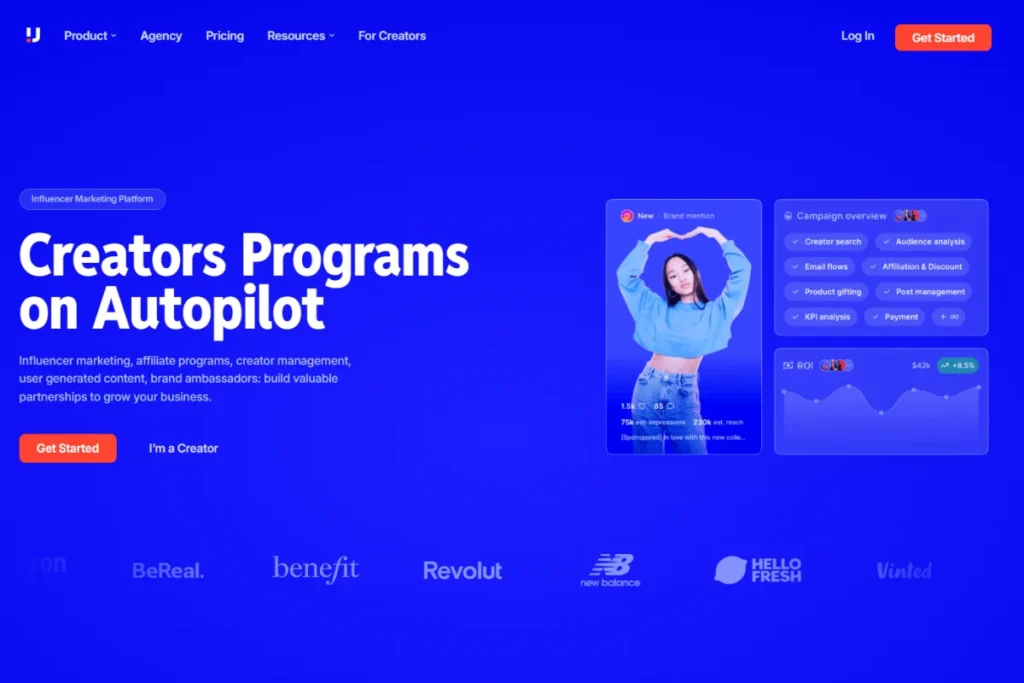
Upfluence is built for ecommerce and affiliate programs that want outreach tied directly to sales. Its automation runs on Upfluence AI (Jaice), an AI agent that goes past recommending creators: it launches campaigns, finds and vets creators, automates outreach, and reports on performance, with guided campaign setup that suggests who to target and how to budget based on more than a decade of creator campaign data.
For outreach specifically, Upfluence’s AI, Jaice, drafts a template once and reworks it for each creator’s platform, language, and niche, then sends from your own Gmail or Outlook so the email lands as a personal message rather than a platform blast. You build automated sequences with conditions and delays, and every message stays editable before it sends. Upfluence AI also powers customer-based discovery through Live Capture, which finds creators already inside your customer list, so a share of your outreach goes to people who already buy from you.
The platform connects natively to Shopify, WooCommerce, Magento, BigCommerce, Amazon, and Klaviyo, which is why it fits ecommerce influencer marketing programs that need creator activity tied to revenue. See the influencer outreach automation workflow for how the sequencing and inbox sending work together, and the Upfluence AI outreach agent for the drafting and campaign side.
Modash
Modash is a discovery-led tool best suited to teams that start from search. Its strength is a large, searchable creator database, paired with email outreach and promo code and link tracking so you can source creators and message them without leaving the tool. It fits structured programs focused on finding creators and running outreach, with performance visibility centered more on engagement than full-funnel revenue.
For ecommerce teams that also need creator-level sales attribution and global payments in the same system, the trade-off is worth weighing directly. See the Upfluence vs Modash comparison for a side-by-side on discovery, tracking, and fit.
Insense
Insense is oriented toward high-volume UGC and creator campaigns. It leans on a creator marketplace where creators apply inbound, plus brief and outreach workflows built to move a lot of collaborations at once. That makes it a fit for brands that want content volume and are comfortable running a marketplace-driven intake rather than outbound discovery.
The consideration for outreach-led teams is that marketplace intake and outbound personalization solve different problems. If your program depends on reaching specific creators with a specific offer, weigh how much of the sourcing is inbound applications versus targeted outreach.
Influencer Hero
Influencer Hero focuses on Instagram-first outreach at scale, with a built-in performance CRM that keeps outreach and relationship tracking in one place. Teams that run most of their program on Instagram and want automated outreach plus a CRM view of every conversation are its natural fit.
If your program spans several platforms or needs creator activity tied to store revenue, factor in how much of the tool is built around a single channel before you commit.
Aspire
Aspire suits template-led DTC programs. Its automation centers on template-driven email and product seeding, with a marketplace where creators can apply, so it fits brands running gifting and ambassador motions at a steady cadence. Product seeding automation is its recognizable strength for consumer brands sending a lot of product.
For teams that want an AI agent handling drafting and campaign setup, or discovery that reaches beyond a marketplace and a template, compare the workflows directly. The Upfluence vs Aspire page breaks down where each fits.
Get Started and see an automated sequence run against your own creator list.
How to Automate Influencer Outreach at Scale
Automation works when the process underneath it is clean. Standardize the three steps below, then let the tool run them.
Build a Targeted Creator List
Automation multiplies whatever list you feed it, so a loose list scales your misses. Use discovery filters to narrow by platform, niche, audience location, and engagement, then vet for audience quality before a single message goes out. A shortlist of 50 well-fit creators outperforms 500 loosely matched ones, because reply rate and conversion both track relevance, not volume.
Set Up Personalized Sequences
Write your first message and your follow-up as templates, then let AI drafting adapt each one per creator. Set a delay between messages, add a condition so anyone who replies drops out of the sequence, and keep every message editable before send. The goal is a sequence that reads as if you wrote each email by hand, because from the creator’s side, you effectively did.
Here is a simple two-message sequence that works for a gifting offer:
Message 1, day 0. Reference a specific recent post, name the product you want to send, and make the ask a single clear question. Keep it under 120 words.
Message 2, day 4 if no reply. One short nudge that adds a reason to say yes now, such as a launch date or a limited product drop. Do not resend the pitch; add to it.
Track Replies and Refine Templates
Watch open and reply rates by template, not just by campaign. When one variant pulls ahead, make it the default and rewrite the laggard. Reply-based status tracking keeps your roster accurate automatically, so your team spends its attention on live conversations instead of bookkeeping. Over a few cycles, this loop is what turns a decent sequence into a reliable one.
Get Started with a guided setup for your first automated program.
Influencer Outreach Email Templates That Get Replies
Templates are only a starting point. The versions below are built to be loaded into a sequence and adapted per creator, not sent as-is.
Gifting offer. “Hi [name], your recent [specific post] caught our eye, especially [detail]. We’d love to send you [product] to try, no strings attached. If it’s a fit for your audience, we can talk about a longer collaboration. Can I ship one to you this week?”
Paid collaboration. “Hi [name], we’re planning a [campaign theme] with a small group of creators and your [content type] is exactly the tone we want. The collaboration is [format] with paid compensation. Would you be open to hearing the details?”
Affiliate invitation. “Hi [name], your audience already trusts your take on [niche], so an affiliate partnership could work well for both of us: you share products you actually like and earn on every sale you drive. Want me to send your link and terms?”
Each of these runs better inside an automated sequence, where AI drafting adapts the specifics per creator and a timed follow-up catches the replies the first send misses. For affiliate offers, tie the outreach to your affiliate program so the link and commission are ready when the creator says yes.
Frequently Asked Questions
What is a good response rate for influencer outreach?
There is no single benchmark, because reply rates swing widely with how targeted and personal the outreach is. Cold, generic outreach to a broad list tends to land in the low single digits, while warm, well-personalized outreach to a tight, relevant list can reach several times that. The lever that moves the number most is relevance: referencing a creator’s real content and making a specific, easy-to-accept offer does more for reply rate than any volume increase.
How much do automated influencer outreach tools cost?
Most outreach tools use custom or tiered pricing rather than a single sticker price, because a brand running one campaign has very different needs from one running hundreds. Common cost drivers include the modules you select, the number of seats, the volume of active creators or profiles in your programs, API usage where it is metered, and payout volume if payments run through the tool. When you compare costs, weigh the time saved on discovery and admin against the price, not the sticker alone. For a plan scoped to your program, see Upfluence pricing.
Is automated influencer outreach compliant with email rules?
Automated outreach stays compliant when it follows the same rules as any business email: send to relevant, appropriate contacts, make it clear who you are, honor opt-outs, and respect your email provider’s sending limits. Sending from your own mailbox rather than a shared bulk domain also protects deliverability, because it keeps your outreach tied to a real sender reputation. Automation does not change your obligations; it just applies them consistently at scale.
Can you automate influencer outreach on Instagram?
You can automate the discovery and email side of Instagram outreach, but automating direct messages is limited and risky. Instagram restricts automated DMs, and platforms enforce sending limits that make bulk DM automation a fast route to a flagged account. The realistic approach is to find creators through Instagram-aware discovery, then reach them by email through an automated sequence, which is more reliable and easier to personalize than DM automation.
How long does it take to see results from automated outreach?
Expect first replies within days of your first send and booked collaborations within the first few weeks, assuming a well-targeted list and a working sequence. The early cycles are as much about learning as booking: you find out which templates and offers land, refine them, and compound the reply rate from there. Results arrive faster when discovery, outreach, and tracking live in one tool, because you can act on what is working without stitching data together by hand.
Choosing the Right Automated Outreach Tool
The right tool is the one that matches your channels, your volume, and your integrations. If you run most of your program on one platform, a channel-focused tool may be enough. If you need outreach tied to store revenue, discovery that reaches your own customers, and payments in the same system, an end-to-end platform earns its cost by removing the seams between tools.
Whichever you choose, the payoff is the same: automate the drafting, sequencing, and follow-up, keep the targeting and the offer in human hands, and reinvest the hours you get back into the creators worth a real conversation. The most direct next step is to set up a single automated sequence against a targeted list and measure the reply rate, then scale what works.
Get Started with Upfluence here.