

Choosing an influencer payment platform usually starts the day payouts stop fitting in a spreadsheet. One creator wants a local bank transfer in euros, and finance wants a single invoice for all of them by Friday. This guide is a shortlist of five platforms, built from current product research rather than a vendor pitch, plus the criteria you can judge any tool against: payout methods, currency and country reach, how it handles tax and compliance, and whether it connects a payout to the sale it drove.
This isn’t a strict ranking. The right platform depends on your program, so each entry leads with the brand it fits best.
TL;DR: The 5 Best Influencer Payment Platforms at a Glance
| Platform | Best fit | Standout strength | Pricing signal |
|---|---|---|---|
| Upfluence Pay | Ecommerce and D2C brands tying payouts to tracked sales | No percentage taken on creator sales, with payouts tied to attribution | Custom plans |
| Modash | Teams that want one consolidated invoice for many creators | Brand pays once; the platform distributes to each creator | Payments on higher tiers; fee-free allowance, then a percentage above |
| Grin | Brands running gifting and creator management alongside payouts | PayPal payouts and 1099 handling inside a creator-management workflow | Self-serve tiers plus enterprise custom |
| Trolley | Finance teams paying large creator rosters through an API | Payout infrastructure built for scale | Modular monthly plans plus per-transaction fees |
| Gigapay | Brands needing tax liability shifted off their books | Merchant of Record model | Quote-based |
What Is an Influencer Payment Platform?
An influencer payment platform is software that pays creators at scale and handles the compliance around it: automated payouts, tax-form collection and reporting, multi-currency support, and, in the stronger tools, a link between each payout and the sales it generated. It replaces the bank-transfer-and-spreadsheet routine most brands start with, which breaks down the moment a program crosses a handful of creators or a single border.
The gap between the two approaches is compliance and traceability. A spreadsheet does not collect a creator’s tax form, flag a failed transfer, or reconcile a payout against revenue. A platform does. The four functions worth checking for are automated payouts, tax and compliance handling, multi-currency support, and sales attribution.
Payment structure sits underneath all of this. Whether you pay a flat fee, a commission, or send product only shapes which platform fits, and the trade-offs between payment versus product deals are worth settling before you shortlist tools.

When Does Your Brand Need an Influencer Payment Platform?
You need an influencer payment platform once manual payouts start costing more than the software would. Three triggers usually mark that point: your active creator count crosses roughly a dozen, you make your first cross-border payout, or finance asks for one consolidated invoice instead of scattered receipts.
Manual payouts hide their cost in admin hours, returned or failed transfers, and the compliance work of collecting tax forms one creator at a time. That cost is measured in time as much as money: running KYC and tax-form collection across hundreds of creators is nearly a standalone job on its own. Every added currency and every added creator multiplies that overhead, and the reporting stays disconnected from the revenue the program actually drove. For commission-based programs the strain is sharper still, because payouts have to be calculated from performance rather than set as a fixed fee, which is where commission-based creator programs benefit most from automation.
Paying creators still feels like payout-day firefighting? Get Started.
The 5 Best Influencer Payment Platforms for Creator Payouts
Each entry covers what the tool is, its standout strength, and the fit or limitation worth weighing. Competitor details below are drawn from each vendor’s own materials and are pending verification.
1. Upfluence Pay
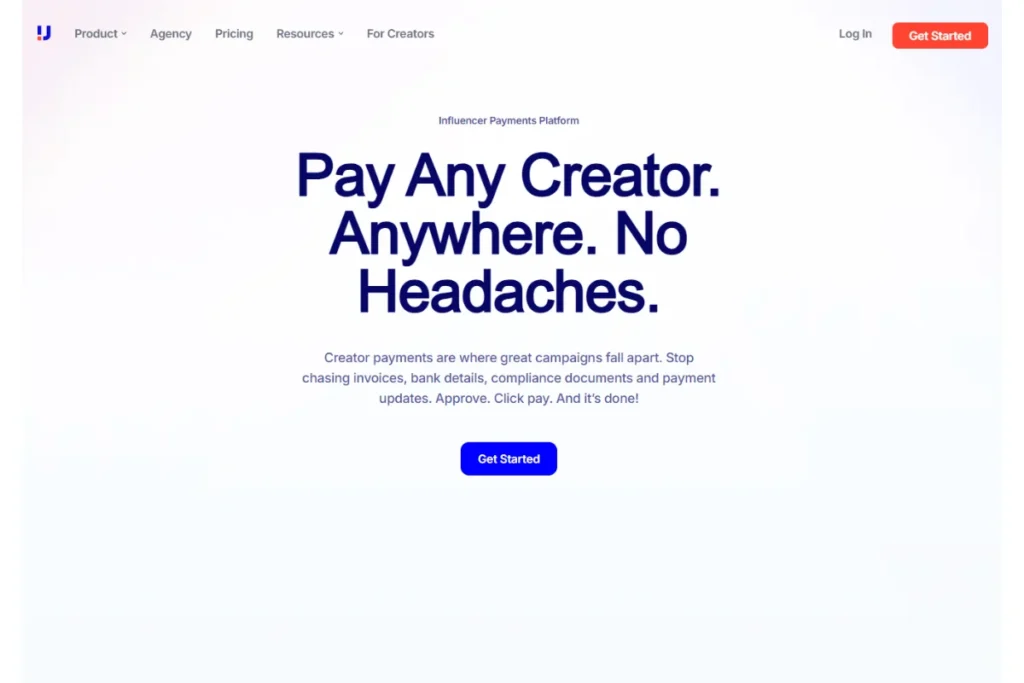
Upfluence Pay is the payments layer of an end-to-end creator marketing platform, so payouts sit next to discovery, outreach, and campaign tracking rather than in a separate tool. The flow is approve, click pay, done: you approve a creator’s work once and pay them in their choice of currency, with bulk multi-currency payouts handled in a single action instead of dozens of manual transfers.
Compliance is built into the payout rather than bolted on afterward. Upfluence Pay collects payout details with built-in KYC verification, retrieves and stores tax forms (1099, W-8/W-9), and exports tax records automatically so finance stays audit-ready. Upfluence takes no percentage of creator-driven sales, so a program that scales does not quietly raise your platform fees.
Payouts also run on role-based approvals: a manager approves the creator’s work and finance releases the payment, a two-checkpoint flow that prevents any one person from paying, say, a creator they know personally. Finance can export all of the compliance documents from the same place, and 1099s are generated automatically.
The standout is attribution. Because the platform is end-to-end, each payout can be tied to the revenue a creator generated through store integrations across Shopify, WooCommerce, and Amazon, so commission is calculated from tracked sales rather than estimated. On the trust side, Upfluence completed a SOC 2 audit covering security, availability, and confidentiality.
Best fit: ecommerce and D2C brands, and the agencies serving them, that want payouts and sales attribution in one system.
2. Modash

Modash is a creator-discovery and influencer-database platform that has added a consolidated payment option. Per its own materials, the brand pays once and Modash distributes to each creator in their local currency, with automated invoicing handled centrally. The standout is that single consolidated invoice, which suits teams paying many creators who do not want to reconcile individual transfers.
Worth weighing: Modash only includes payouts on its higher-priced plans, and once you pass a set fee-free payout amount, it charges a percentage on everything above it.
3. Grin
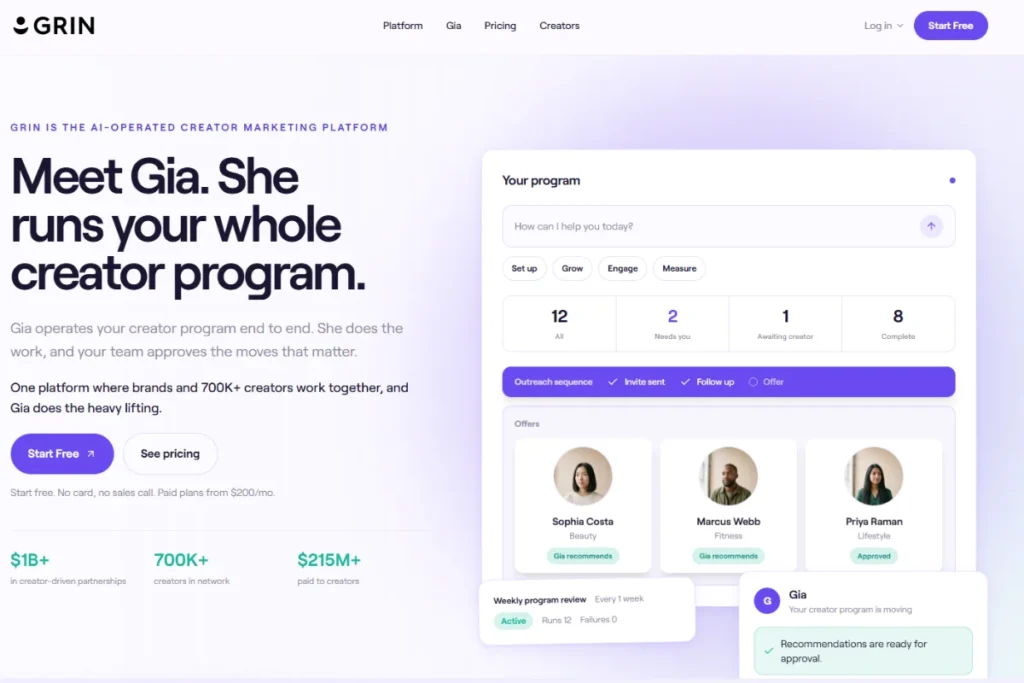
Grin is a creator-management platform aimed at DTC and ecommerce brands. It is management-first, with payouts routed through a PayPal integration and 1099 generation and collection alongside payment tracking, per its own materials. The fit is brands already running gifting and creator management who want payouts attached to the same workflow.
Worth weighing: the PayPal routing is worth checking against the payout preferences of an international creator roster and PayPal-based payout workflows tend to stay fairly manual once volume climbs.
4. Trolley
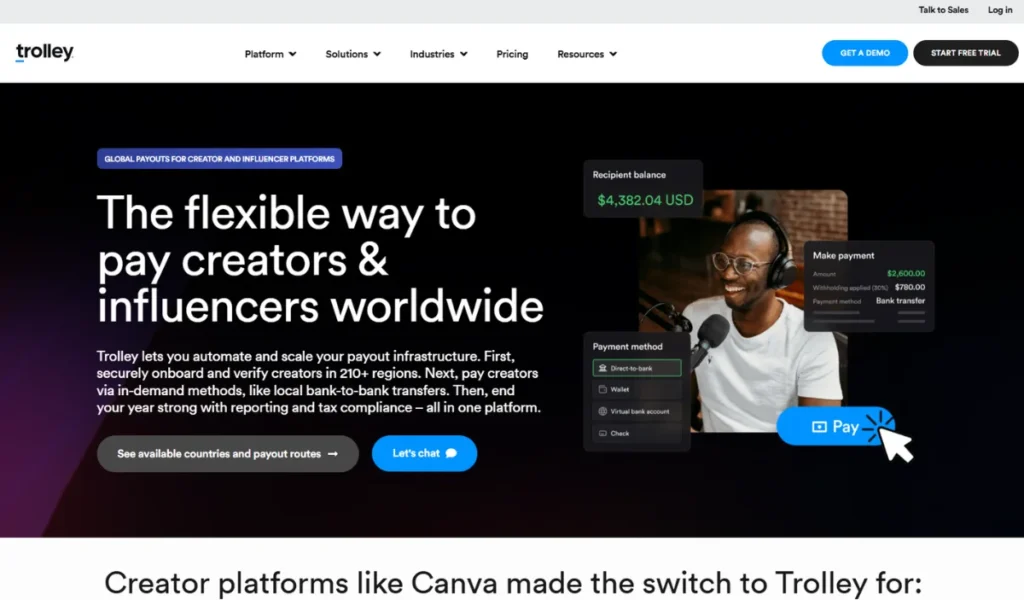
Trolley is a payout infrastructure rather than an influencer-marketing tool, built for finance teams paying large rosters through an API. Per its own materials, it supports bank transfer, e-wallet, PayPal, and check across a broad country and currency range. The fit is scale and engineering control.
Worth weighing: tax filing sits in a separate module, and per-transaction fees plus an FX markup are cost factors. Because it handles payouts only, discovery and attribution live elsewhere in your stack.
5. Gigapay

Gigapay uses a Merchant of Record model: per its own materials, it becomes the contracting and paying party, which shifts tax liability off the brand. That is the distinction most tools skip, and it is covered in the section below. The fit is brands that specifically want tax liability moved off their books. Worth weighing for US, Canada, and UK programs: Gigapay’s stated compliance focus leans European (including DAC7 reporting), so confirm coverage for your regions before committing.
Want to see payouts and attribution running in one place? Get Started.
Features to Compare Before Choosing an Influencer Payment Platform
Four capabilities separate these tools in practice: payout methods, currency and country reach, tax and compliance handling, and whether payouts connect to sales. Match them to your program rather than to the longest feature list.
| Platform | Payout methods | Currency and country reach | Tax and compliance | Sales attribution |
|---|---|---|---|---|
| Upfluence Pay | Multi-currency transfers, local bank transfer, and PayPal | Global; creator’s choice of currency | Built-in KYC; automated 1099, W-9, and W-8 tax forms; automatic tax-record exports | Per-creator revenue tracking through store integrations |
| Modash | Local bank transfer in the creator’s currency | 36 currencies, 180+ countries (vendor-stated) | Central invoicing and tax handling (vendor-stated) | Shopify affiliate sales attribution (vendor-stated) |
| Grin | PayPal-routed payouts | PayPal-dependent, US-centric (vendor-stated) | 1099 generation and collection (vendor-stated) | Campaign ROI reporting (vendor-stated) |
| Trolley | Bank transfer, e-wallet, PayPal, check | 135+ currencies, 210+ countries (vendor-stated) | Separate tax module (IRS, DAC7 filing) (vendor-stated) | None; payout infrastructure only |
| Gigapay | Local rails (SEPA Instant, Faster Payments, ACH) | 50+ currencies, 65+ countries (vendor-stated) | Merchant of Record; tax liability transferred (vendor-stated) | None; payouts and compliance only |
One distinction worth understanding before you compare: Merchant of Record versus payment processor. A payment processor moves your money to creators; you remain the paying party and carry the tax and reporting liability. A Merchant of Record becomes the paying party itself, so the liability shifts to the provider. Neither is universally better. A processor keeps you in control of the relationship and the data; a Merchant of Record trades some of that control for less compliance exposure. Which one fits depends on how much tax risk you want to carry in-house.
The capability most comparison guides skip is the last column. Payout infrastructure moves money well, but stops at the transfer, which means your reporting still lives apart from your revenue. A platform that connects payouts to store data lets you pay on tracked performance and see return per creator in the same place.
How to Choose the Right Platform for Your Creator Program
The clearest way to decide is by program type, because each one weights the four capabilities differently.
- Ecommerce and affiliate programs. When payouts are tied to sales – commission, affiliate, revenue-share – attribution is the deciding capability, not payout reach. You want the payout calculated from tracked revenue rather than reconciled by hand, which favors a platform that connects to your store. Settle your rate structure first; a guide to how much to pay influencers helps size commissions before you automate them.
- Global rosters. If you pay creators across many countries, lead with currency and country reach, and local payout rails, so creators receive funds the way they expect in their own currency. Confirm the platform’s compliance coverage maps to the regions you actually operate in.
- Finance-led payout operations. If a finance or operations team owns payouts at high volume, look for role-based controls, not just an API. In Upfluence, finance and campaign managers hold separate roles: a manager approves the creator’s work, and finance releases the payment. That two-checkpoint flow keeps any one person from paying, say, a creator they know personally. Finance can also export all of the compliance documents from the same place, and 1099 forms are generated automatically.
Once you have shortlisted by type, pressure-test the cost against your program size. Public pricing is thin across this category, so compare Upfluence pricing and each vendor’s fee structure against your creator volume and payout frequency rather than the sticker plan.

Frequently Asked Questions
Quick answers to the questions brands and creators ask most about paying influencers.
Do Influencers Need A Registered Business To Get Paid?
Not always – it depends on the country and the platform’s onboarding rules. Some platforms let creators onboard as individuals without a registered company or VAT number, while others require business details for higher payout volumes or specific regions. Merchant of Record models often absorb more of this by contracting with the creator directly. Confirm the specific platform’s onboarding requirements, and check local rules with a tax professional.
Can Brands Pay Influencers With Products Instead Of Money?
Yes. Product gifting is a common compensation route, and creators most often accept it early in a relationship or when the product fit is strong. Keep in mind that product-only deals can still carry tax-reporting obligations, since the value of gifted goods may be treated as compensation depending on the jurisdiction and amount. Treat it as a real payment for record-keeping, not a way around it.
Do Brands Need A Contract Before Paying Influencers?
A written agreement is strongly advised, because it protects both sides on rates and deliverables and gives you recourse if the work does not arrive. A basic influencer payment agreement should cover the deliverables and timeline, the rate and payment terms, content usage and licensing rights, and required disclosure compliance (such as FTC endorsement rules in the US). This is general guidance, not legal advice, so have counsel review your template.
What Happens If A Creator Does Not Deliver After Payment?
The cleanest protection is to avoid paying up front: approval-gated payouts release funds only after deliverables are approved, which keeps the money with you until the work lands. If funds have already moved, your recourse depends on the contract, which is why the written agreement matters, and practical options narrow considerably once a payment clears. Structuring payouts around approval is far more reliable than chasing a refund.
Your Next Step
The right influencer payment platform comes down to three questions in order: which currencies and compliance models your creators actually need, whether your payouts have to connect to tracked sales, and how much tax liability you want to keep in-house. Answer those and the shortlist narrows itself.
If attribution is on that list, the case for an end-to-end platform is strongest – one system that runs creator discovery, ties payouts to ecommerce revenue, and pays creators worldwide without a separate payout tool. Map your requirements, pick the two capabilities you cannot compromise on, and pilot against a live payout cycle before you commit.
Ready to pay creators without the payout-day scramble? Get Started.