

Most brands start looking for Traackr alternatives over one issue: return on investment. Traackr runs a smaller creator pool than Upfluence and costs far more, so the return gets harder to justify as a program grows and starts driving sales. Traackr still earns real credit as a strong system of record for measuring influence at scale, but that measurement strength is a harder fit once your team needs to find creators, run campaigns, and tie results back to revenue in one place.
This guide names the decision that actually determines fit. You are usually leaving for one of three reasons: you need a larger or fresher discovery pool, you need execution and workflow instead of dashboards, or you need pricing and integrations that match a growing commerce program. Match the tool to the reason, not to a logo in a roundup.
TL;DR: The 6 Best Traackr Alternatives
Here is the shortlist before you scroll. Verify every price against each vendor’s live pricing page, since most sell by custom quote and figures move.
| Platform | Best for | Pricing model | Key difference from Traackr | Limitations |
|---|---|---|---|---|
| Upfluence Pay | Ecommerce and DTC brands wanting discovery plus revenue tracking | Custom quote | Ties creator activity to Shopify, Klaviyo, and Amazon sales rather than intelligence dashboards alone | Built for ecommerce, so less suited to pure brand-awareness programs |
| Modash | Fast discovery across a large creator database | Free trial, then paid monthly | Database-first search without an enterprise floor | Lighter on end-to-end campaign workflow and payments than a full suite |
| Grin | Ecommerce brands running creators end to end | Custom quote | Deep Shopify and WooCommerce workflows built for execution | Best fit assumes a Shopify or WooCommerce store |
| Aspire | Brands building long-term creator communities | Custom quote | Relationship and community tools over competitive benchmarking | Heavier setup for small teams |
| Influencity | Teams that want automation and campaign execution | Paid monthly tiers | Outreach and workflow automation rather than a static system of record | Smaller creator database than database-first tools |
| HypeAuditor | Vetting creators and audience quality | Paid monthly tiers | Upfront fraud detection and fake-follower checks | Analytics-led, so thinner on end-to-end campaign management |
Where Traackr Falls Short for Growing Brands
Traackr does real work well. Its enterprise benchmarking, brand-health scoring, and multi-market program tracking are genuine strengths for large teams that need to measure share of voice across regions. If your core job is intelligence and reporting, that is what Traackr is built for.
The friction shows up when the program starts driving sales rather than awareness. Four gaps come up most often for growing brands.
The cost floor is set for enterprise. Third-party market-data listings put Traackr in the range of roughly $25,000 to $55,000+ per year, quoted annually, with industry benchmarking sold as a separate add-on (Software Finder, 2026). That is a large commitment to make before your first campaign runs.
It is an intelligence tool, not an execution platform. Traackr is strong at telling you who matters and how a program performed. It does less to help you run the outreach, manage the workflow, and attribute revenue, which is where a growing team spends most of its hours.
The database is shared and finite. Traackr draws from a curated profile pool that many brands query. That is fine for benchmarking, but it can leave you fishing in the same water as everyone else when you need fresh, niche creators your competitors have not already booked.
The API is gated behind a large additional price. Traackr’s programmatic access sits high in its pricing tiers rather than coming standard, so piping data into your own stack costs extra on top of an already enterprise bill. In an era of AI tools and MCP, where programmatic access is how teams connect and automate their systems, gating the API this heavily makes less and less sense, and the gap compounds the three above.
A steep learning curve and lighter ecommerce integration compound the gap. None of this makes Traackr a bad platform. It makes it the wrong shape for a brand that now needs discovery, execution, and revenue attribution in one system.

What to Look for in a Traackr Alternative
Turn each capability into a question you ask on the demo call. Three differences separate an intelligence suite from an execution platform, and they matter more than any feature list: execution, price and ROI, and integration.
Execution: does the platform run the campaign or only inform it? Upfluence makes execution automatic, handling outreach, briefs, approvals, and reporting inside one system, while Traackr focuses on making compliance, PR-risk screening, and global competitor intelligence easier. Those are genuine Traackr strengths, so the real question is what happens after you find a creator: whether the outreach and follow-up work runs on the platform or lands back on your team.
Price and ROI: is the return on investment clear? Seats, modules, active profiles, and API usage all move the bill, so get the real cost drivers before you compare quotes. Then ask whether the tool can tie sales to a specific creator rather than just count reach, because attributed revenue is the number that funds next year’s budget.
Integration: how does it connect to your store and your payments? For a commerce program, native integrations with Shopify, WooCommerce, Amazon, and your email platform decide whether creator activity ever reaches revenue. Without them, a program can measure influence all day and still never prove a sale.
One more to pressure-test alongside those three: how large and fresh is the discovery pool, and how do you search it? A database-first tool and a workflow-first tool solve different problems, so decide whether you need reach across a big index or depth inside your own audience.
| Criterion | Score the tool on |
|---|---|
| Discovery pool | Size, freshness, and search method |
| Execution | Outreach, briefs, approvals, reporting in-platform |
| Commerce integrations | Shopify, WooCommerce, Amazon, Klaviyo |
| Revenue attribution | Sales tied to a creator rather than reach |
| Pricing model | Seats, modules, active profiles, API usage |
Ready to see discovery and attribution in one workflow? Get Started.
The 6 Best Traackr Alternatives
Here are the six platforms worth shortlisting, ordered by fit for a brand leaving Traackr rather than by company size. Each entry follows the same shape: who it fits, where it is strong, and one honest trade-off.
Upfluence
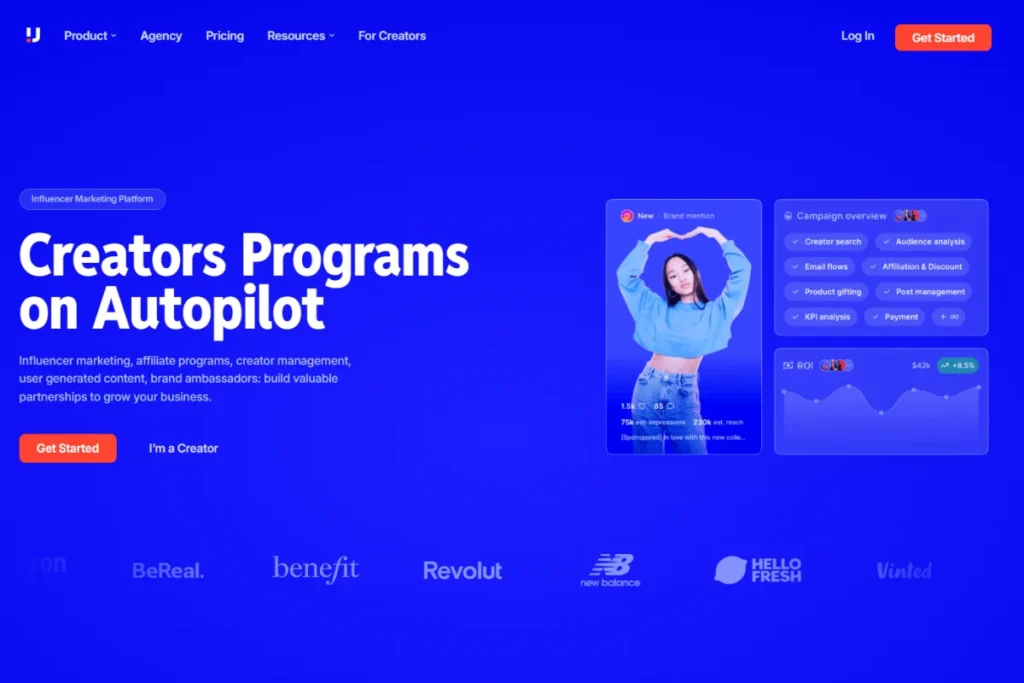
Who it fits: ecommerce and DTC brands that want discovery, execution, and revenue in one platform.
Upfluence leads with Upfluence AI (Jaice), an agent that runs the parts of a program that usually eat a team’s week. Jaice sets up campaigns with guided targeting, finds and vets creators, automates outreach, and reports on performance, drawing on years of creator-campaign data to recommend who to work with. Its other distinctive capability is Live Capture, which identifies creators hiding inside your own customer and email lists, so discovery starts with people who already buy from you.
Where Traackr informs, Upfluence executes and attributes. Native integrations with Shopify, WooCommerce, Magento, BigCommerce, Amazon, and Klaviyo connect creator activity to store sales, and ecommerce influencer marketing ties the whole program to revenue rather than to a dashboard. Payments run inside the same system, with built-in KYC, automated 1099, W-9, and W-8 tax forms, local bank transfer, PayPal, and bulk multi-currency payouts. Upfluence takes no percentage of creator-driven sales, and finance and campaign roles are separated so a manager approves a payout and finance releases it, a two-checkpoint control that keeps compliance clean.
The honest trade-off: it is built for commerce, so a pure brand-awareness program with no revenue goal will use less of what makes it strong. Pricing is a custom quote based on modules, seats, and API usage.
Modash
Who it fits: teams that want fast, database-first discovery without an enterprise commitment.
Modash centers on a large creator index you can search and filter quickly, with a free trial that lowers the risk of switching. For a brand leaving Traackr mainly for scale and price, it is an easy first look. You can read the full picture in our Upfluence and Modash comparison.
The honest trade-off: it is lighter on end-to-end campaign workflow and payments than a full suite, so execution-heavy teams may outgrow it.
Grin
Who it fits: ecommerce brands that want to run creators end to end on top of their store.
Grin is built around ecommerce creator management, with deep Shopify and WooCommerce workflows for gifting, tracking, and relationship management. If your program lives inside a Shopify store, it maps closely to how you already work. See the side-by-side in our Upfluence and Grin comparison.
The honest trade-off: that store-native design is also the limit. The best fit assumes a Shopify or WooCommerce backend and gets less flexible off it.
Aspire
Who it fits: brands building long-term creator communities rather than one-off campaigns.
Aspire leans into relationship and community building, with tools for recruiting, nurturing, and managing an ongoing roster of creators and brand advocates. For teams that treat creators as a community to grow over time, that focus is the draw. Compare the approaches in our Upfluence and Aspire comparison.
The honest trade-off: the community-first setup is heavier for a small team to stand up, and it emphasizes relationships over competitive benchmarking.
Influencity
Who it fits: teams that want automation and campaign execution over a static system of record.
Influencity focuses on outreach sequences, workflow automation, and audience-overlap analysis, so more of the campaign runs on rails. For a brand leaving Traackr because it wants to do rather than only measure, that execution focus is the appeal, and its paid monthly tiers are more accessible than an enterprise contract.
The honest trade-off: its creator database is smaller than the database-first tools, so reach-led discovery is not its strength.
HypeAuditor
Who it fits: teams whose first priority is vetting creators and audience quality.
HypeAuditor is analytics-led, with upfront fraud detection and fake-follower checks that help you avoid paying for hollow reach. As a vetting layer, it does one job well and is simple to buy on monthly tiers.
The honest trade-off: that same focus makes it thinner on end-to-end campaign management, so most teams pair it with an execution platform rather than replacing one.
Traackr Alternatives by Team and Budget
The right pick depends as much on how your team is built as on the feature list. Here is how the shortlist maps to three common profiles.
Ecommerce and DTC brands
Pick the tools that connect creators to store revenue. Upfluence and Grin both tie creator activity to Shopify and, in Upfluence’s case, to Amazon and Klaviyo as well, so sales attribution is native rather than bolted on. If commissions and performance payouts are core to your model, affiliate marketing tracking that lives beside discovery keeps the whole program in one system.
Agencies managing multiple clients
Prioritize client workspaces, approval flows, and reporting you can hand to a client without exporting to a spreadsheet. Watch how pricing scales here: per-seat or per-client models change the math quickly once you run several programs at once, so price the tool at the number of clients you actually serve.
Lean and mid-market teams
Favor lower-cost, self-serve options that let you validate the channel before committing. Modash and Influencity both let a small team get moving without an enterprise floor, and free tools are a low-risk way to test discovery before you buy.
Want discovery, execution, and payments in one place instead of three? Get Started.
What to Expect When Switching from Traackr
Most of your program history carries over with a clean export. Creator lists, campaign records, and performance reporting can move, but pull them out of Traackr before you give notice, since export access gets harder once a contract winds down. Treat the export as the first migration task, not an afterthought.
Set a realistic onboarding timeline and migrate one program first rather than everything at once. Pick a single active campaign or your highest-value creator segment, stand it up in the new platform, and confirm that discovery, outreach, and reporting all behave before you move the rest. Upfluence has a dedicated onboarding team that helps map your existing creator relationships and history into the new system, which shortens the gap where nothing is running.
For brands leaving Traackr specifically to get discovery and revenue in one place, Upfluence is the natural destination: the same system finds creators, runs the campaign, and attributes the sales, so the program you rebuild is simpler than the stack you left.

Frequently Asked Questions
Does Traackr offer a free trial?
Traackr does not offer a standard self-serve free trial. Access is arranged through its sales team, typically as a guided demo or a scoped evaluation rather than an open signup. Some third-party listings reference a trial period, but it is not a public, self-service option, so plan to go through sales to see the platform (Software Finder, 2026).
What is the difference between Traackr and Upfluence?
Traackr is an enterprise intelligence and benchmarking platform: it is built to measure influence, brand health, and program performance across markets. Upfluence is an execution platform: it finds creators, runs the campaign through Upfluence AI (Jaice), and attributes revenue through native ecommerce and payment integrations. In short, Traackr tells you how a program performed, while Upfluence runs the program and ties it to sales.
What social platforms and countries does Traackr cover?
Traackr indexes creators across the major social platforms, including Instagram, YouTube, TikTok, Twitch, and Snapchat, with multi-market and multi-language coverage aimed at global programs. Exact platform and country coverage shifts over time, so confirm the current list on a demo if a specific market is critical to your program.
Does Traackr have an open API for integrations?
Traackr’s API access is reported to be limited and gated to its higher pricing tiers rather than offered as an open, self-serve integration layer, and it is typically priced as a large add-on. If programmatic access or data piped into your own tools matters, especially as AI tools and MCP make programmatic access more valuable, treat API availability and cost as a specific line item to confirm with sales before signing.
Does Traackr work for B2B influencer marketing?
Traackr can support B2B programs, since its discovery and measurement work across categories, but its strengths are concentrated in consumer verticals like beauty, fashion, and CPG. B2B programs that lean on niche, smaller-audience creators or on lead attribution rather than retail sales often need different tooling to close the loop.
Choosing the Right Traackr Alternative
The right replacement comes down to one question: do you need intelligence, execution, or revenue attribution? If measurement and benchmarking are the whole job, Traackr is hard to beat. If your program now has to find creators, run campaigns, and prove sales, you need a platform built for execution.
Map your reason for leaving to the shortlist, then start with the one program that hurts most today. For brands that want discovery, campaign execution, and revenue tracking in a single system, Upfluence is the most direct next step. Get Started.