

Most teams start shopping for Modash alternatives at the same moment: discovery is working fine, and everything after discovery still lives in a spreadsheet, a separate affiliate tool, and a payment process nobody owns. Switching platforms is a budget decision and a workflow decision at the same time, and getting it wrong costs you a quarter. This comparison gives you published pricing, verified review data, and a pick per team type.
Here’s what you’ll get out of it:
- Real numbers. Current published pricing for all five platforms, benchmarked against what Modash charges.
- A capability checklist. The four things that separate a discovery tool from a platform that your finance team will accept.
- A pick by team type. Agency, DTC, and ecommerce, or enterprise, so you can stop reading early.
- A migration path. What to export, when to time the contract, and how long onboarding actually takes.
TL;DR: Top 5 Modash Alternatives for Different Brand Needs
| Tool | Standout feature | Scope to weigh | Best for | Published entry price |
|---|---|---|---|---|
| Upfluence | Native affiliate tracking and ecommerce revenue attribution | Custom-quoted, so a call is required to get a number | DTC and ecommerce brands | Custom quote, three modular plans |
| HypeAuditor | Fraud detection and audience quality scoring | Advanced filters and recruitment tools sit on higher tiers | Analytics-first vetting | From $299/mo, billed annually |
| Grin | Creator relationship management, priced in usage credits | Monthly credits reset and do not roll over | Enterprise DTC ecommerce | Free tier; paid from $200/mo |
| Heepsy | Entry-level discovery database | Shopify integration and lookalike search on the top tier | Small teams and tight budgets | Free tier; paid from $69/mo |
| Favikon | Creator ranking and monitoring across nine channels | Built around discovery and monitoring rather than campaign execution | B2B and LinkedIn creators | From $199/mo ($159 annual) |
Pricing and features taken from each vendor’s published information and verified on 29 July 2026. Confirm directly before you budget.
Modash Reviews and What Users Say
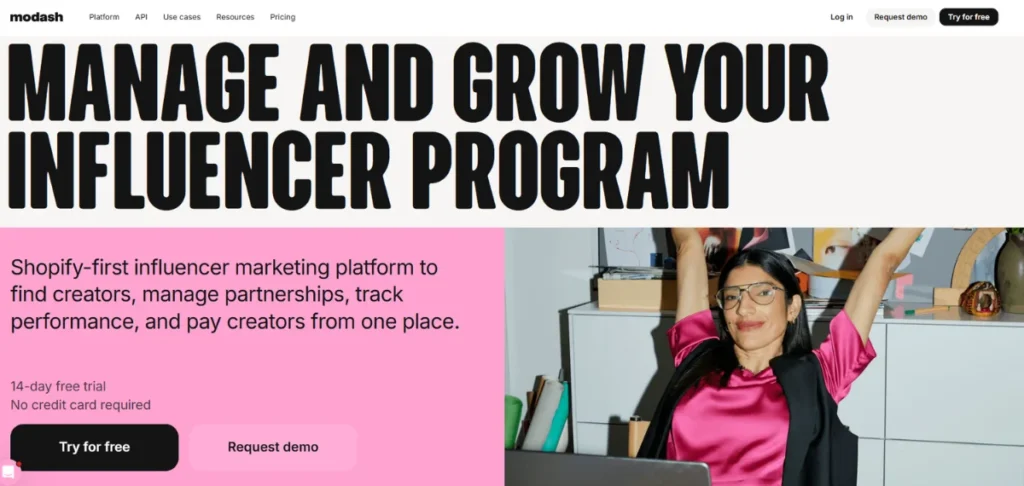
Modash publishes that more than 2,600 in-house teams run paid partnerships, gifting, and affiliate programs on the platform. On the Shopify App Store, where the listing is tied to verified installs, Modash holds a 5.0 rating across 16 reviews as of 29 July 2026. That’s a strong score on a small base, which is the honest way to read it: the teams using it are happy, and there aren’t many public reviews yet to test that against.
The themes reviewers raise are consistent:
- Discovery filters are the reason people stay. Reviewers describe finding creators who fit the brand rather than working through generic suggested lists.
- The CRM replaces the spreadsheet. Tagging creators, tracking pipeline stage, and keeping contact history in one place comes up repeatedly.
- Content tracking works without creator sign-up. Reviewers highlight that campaign content and Instagram Stories get collected without the creator joining anything.
- The product ships fast. Multiple reviewers mention email and outreach tooling improving noticeably over months rather than years.
What the reviews do not tell you is how the platform behaves outside its core scope. Modash covers Instagram, TikTok, and YouTube, and its ecommerce integration is Shopify. If your program runs on other channels or other storefronts, the review sentiment above was formed under conditions that will not match yours.
What to Look for in a Modash Alternative
Before you compare vendors, get clear on which four capabilities you’re actually buying. Creator marketing doesn’t have a performance problem. It has an execution problem, and most platforms only solve part of it.
- Database accuracy and refresh cadence. A creator’s follower count and engagement rate move constantly, and a stale profile means you pay a rate that no longer matches the audience. Ask any vendor how often each data layer refreshes, not just how big the database is. Size is a procurement talking point. Freshness changes your campaign outcome.
- Audience vetting and fraud detection. Follower counts are the easiest metric to inflate and the least useful to buy against. You want audience demographics, credibility scoring, and engagement quality on the same screen as the creator. Our guide to influencer selection metrics covers which signals hold up under scrutiny.
- Campaign management and outreach at volume. Activating one partnership takes 8 to 10 touchpoints across outreach, follow-up, and negotiation. Multiply that by a roster of fifty and the tool either automates the follow-up or you hire someone to do it. Check whether outreach, briefs, approvals, and contracts live in the platform or in your inbox.
- Affiliate and revenue attribution. This is where most discovery-first tools stop. If you can’t connect a creator’s post to a tracked sale, you’re reporting on reach to a finance team that funds revenue. Platforms with influencer analytics built in let you tie content to conversions rather than exporting to a spreadsheet.
- Pricing transparency belongs on the checklist too, though it cuts both ways. Published tiers let you budget without a sales call. Custom quotes let you pay for the modules you use rather than a bundle you don’t. Neither model is automatically better, and how Upfluence pricing works is worth understanding before you assume a published number is the cheaper option.
Ready to see what end-to-end looks like? Get Started here.
Top 5 Modash Competitors
Each entry leads with who it fits, what it does well, and the scope limit worth weighing. Every price below is what the vendor published as of 29 July 2026.
Upfluence
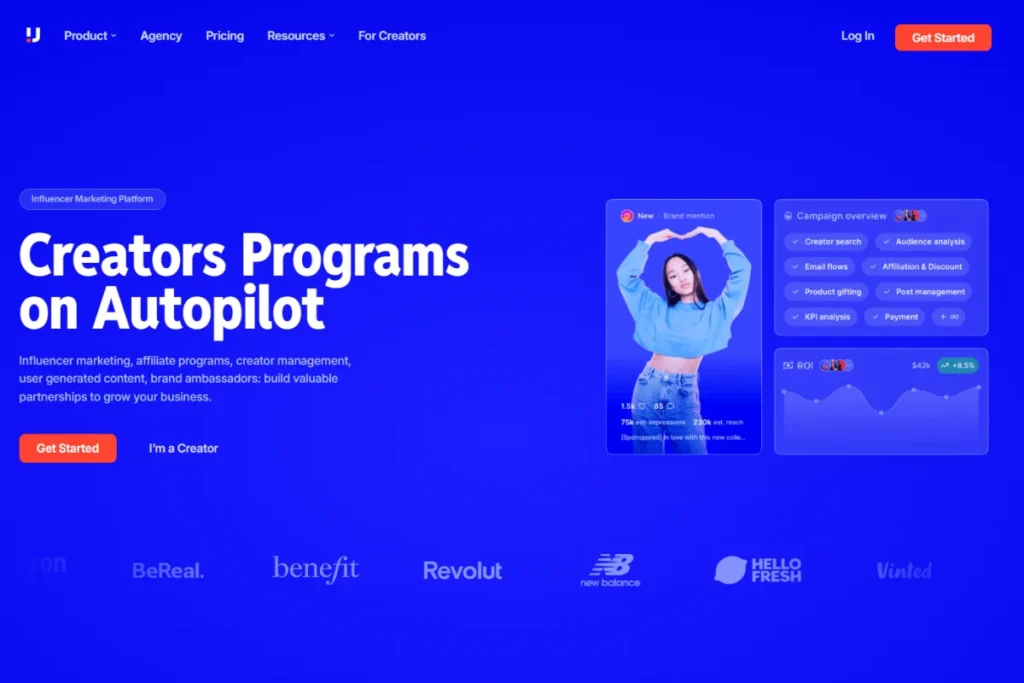
Best for: DTC and ecommerce brands that need creator activity to show up in revenue reporting.
Upfluence covers discovery, vetting, creator CRM, campaign execution, affiliate tracking, and creator payments in one platform. Discovery runs across Instagram, TikTok, YouTube, Twitch, and Pinterest, with an influencer search platform that filters on audience and performance data rather than follower count alone. Upfluence AI (Jaice) personalizes outreach at volume.
Two mechanisms change the economics. Live Capture identifies creators sitting inside your existing customer or mailing database, and runs across Shopify, WooCommerce, Magento, BigCommerce, Amazon, and Zapier. Upfluence Pay handles global payouts with built-in KYC, tax forms, invoicing, and bulk multi-currency, and takes no percentage of creator-driven sales.
Scope to weigh: pricing is modular and custom-quoted across three plans, so an initial call is required to get a number. The free trial is configured after that call rather than being self-serve.
HypeAuditor
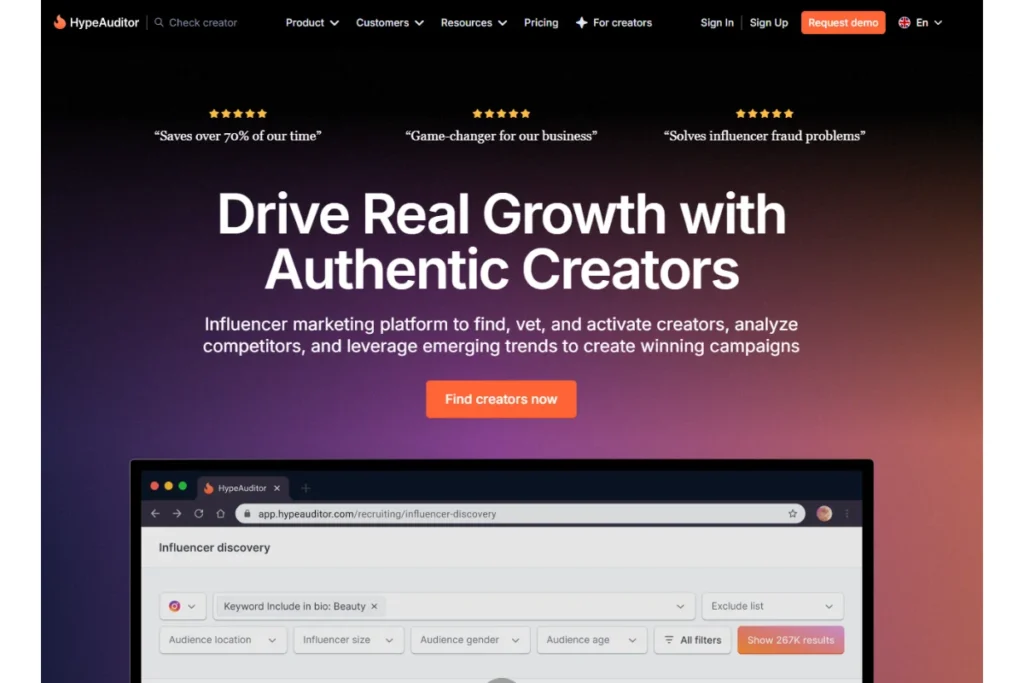
Best for: teams whose bottleneck is vetting rather than execution.
HypeAuditor’s defining capability is data quality. Audience quality scoring and fraud detection are what teams reach for when they need to validate a creator list before committing budget. The platform publishes that every plan includes the same modules, with tiers set by usage limits rather than feature gates.
Pricing starts at $299 per month billed annually, per HypeAuditor’s own published guidance. API and Model Context Protocol (MCP) access are available as add-ons.
Scope to weigh: AI Search, account quality score filtering, lookalike search, competitor monitoring, and recruitment features such as identifying creators among your existing customers all unlock at Pro and above. If those are core to your workflow, the entry tier will not cover them.
Grin
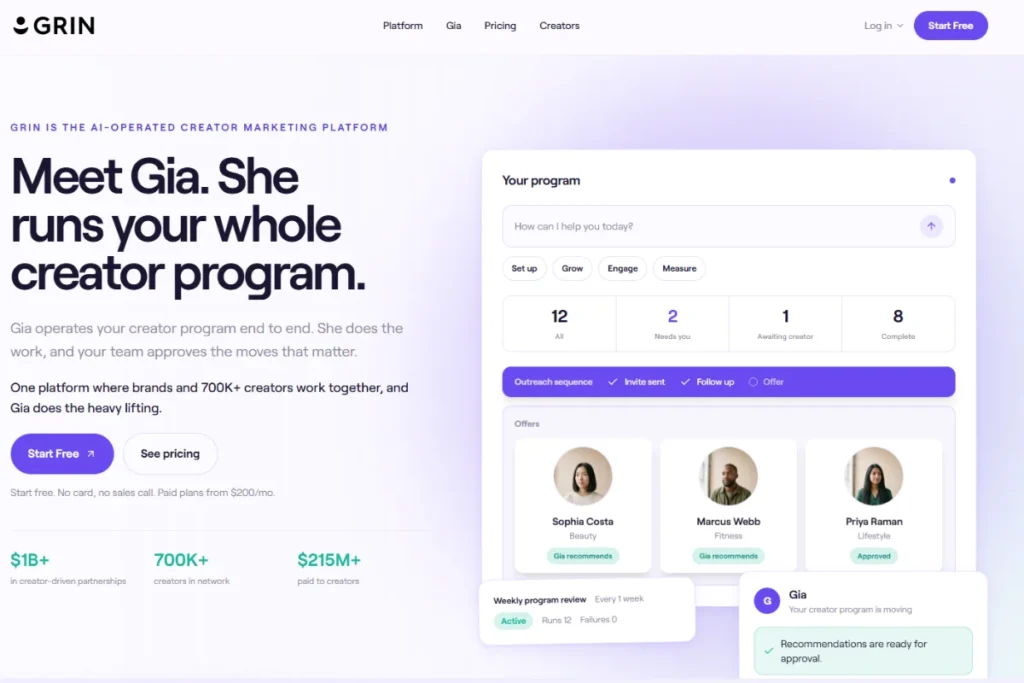
Best for: enterprise DTC ecommerce teams managing large creator rosters.
Grin is built around creator relationship management for direct-to-consumer brands, with Shopify integration. Grin now prices its AI product in usage credits rather than seats: a free tier with 200 monthly credits, Starter at $200 per month with 2,000 credits, and Growth at $500 per month with 7,500 credits, with higher tiers above that. Plans are month-to-month, with no annual commitment and no required sales call to start.
Scope to weigh: included monthly credits reset each billing cycle and do not roll over, though credits bought as overage do. If your program is seasonal, model your peak month rather than your average one.
Heepsy
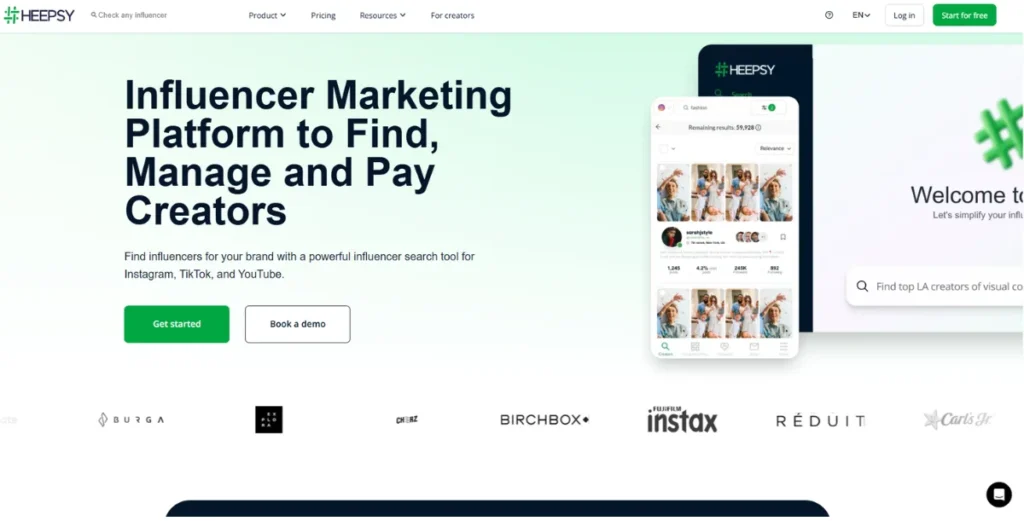
Best for: small teams and tight budgets running discovery-led campaigns.
Heepsy is an entry-level discovery database covering Instagram, TikTok, and YouTube, with authenticity filtering and demographic search. Published tiers run from a free plan through Starter at $69 per month, Plus at $199, and Advanced at $299. Starter includes 15,000 search results and 50 influencer analyses per month, which is the constraint that bites first.
Scope to weigh: Shopify integration and lookalike search sit on the Advanced tier, so ecommerce attribution costs the most here in relative terms.
Favikon
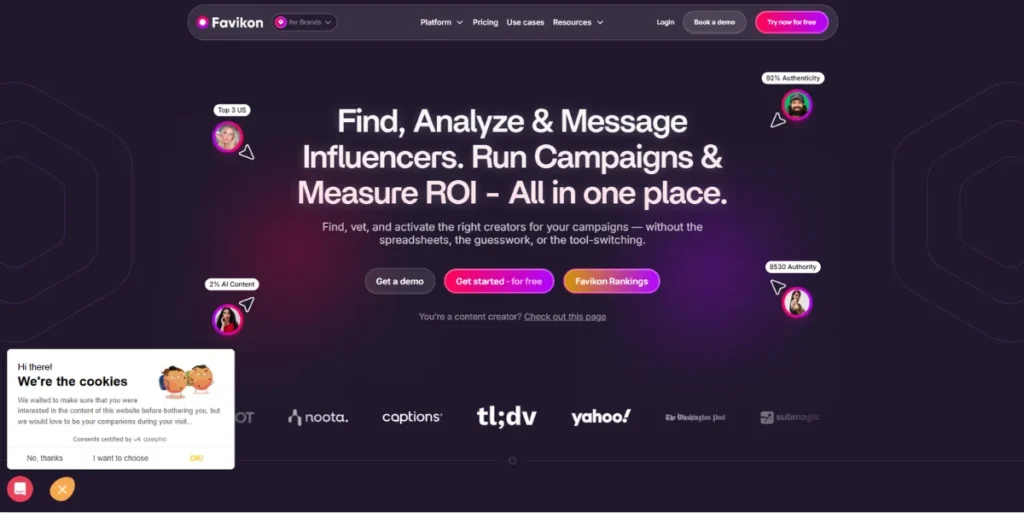
Best for: B2B programs and brands working with LinkedIn creators.
Favikon indexes creators across nine channels including LinkedIn, Substack, X, and Snapchat alongside the usual three, which makes it the outlier here for B2B and thought-leadership programs. It’s organized around creator rankings, monitoring, and lookalike discovery. Core is $199 per month or $159 billed annually, and Pro is $299 per month or $239 annually, both with a 7-day free trial.
Scope to weigh: the product is built around finding and tracking creators rather than executing and attributing campaigns end to end. Capacity is metered in credits, contacts, and active campaigns.
How The Five Compare Against Modash
| Modash | Upfluence | HypeAuditor | Grin | Heepsy | Favikon | |
|---|---|---|---|---|---|---|
| Entry price | $299/mo, or $2,388/yr | Custom quote | $299/mo annual | Free; $200/mo paid | Free; $69/mo paid | $199/mo ($159 annual) |
| Second tier | $599/mo, or $5,988/yr | Custom quote | Quote-based | $500/mo | $199/mo | $299/mo ($239 annual) |
| Free trial | 14 days, no card | After initial call | On request | Free tier, no card | Free plan | 7 days |
| Platforms covered | Instagram, TikTok, YouTube | Instagram, TikTok, YouTube, Twitch, Pinterest | Major social platforms | Major social platforms | Instagram, TikTok, YouTube | 9 channels incl. LinkedIn |
| Ecommerce integrations | Shopify | Shopify, WooCommerce, Magento, BigCommerce, Amazon | Varies by tier | Shopify | Shopify, top tier only | Not core |
| Affiliate and payments | Payouts to 180+ countries; 5% fee on affiliate payouts above the first $10k/year | Affiliate tracking; no commission on creator-driven sales | Not core | Affiliate links and codes | Creator payments included | Not core |
| Pricing model | Published tiers | Modular, custom-quoted | Usage-metered tiers | Usage-based credits | Published tiers | Published tiers |
Want a number for your program? Get Started here.
How to Choose and Switch to the Right Modash Alternative
Match the criteria to your team before you match them to a vendor. Three questions settle most of it.
- How big is the team, and who touches the platform? Seat and usage limits are the most common reason a plan that looked affordable in month one costs more in month three. Modash caps Essentials at two team members and 300 profile analyses; Heepsy’s Starter allows 50 analyses. Count everyone who needs access, including finance and any agency partner, then check the tier that actually covers them.
- Does attribution matter to how you’re measured? If your budget gets renewed on revenue rather than reach, tracked sales, affiliate codes, and payment records need to live in the same system as the creator. If you’re measured on awareness, a discovery-first tool covers you and costs less.
- Where do you sell? Shopify-only brands have the widest choice here, since four of the six platforms in this comparison integrate with Shopify first. Brands on WooCommerce, Magento, BigCommerce, or Amazon should confirm native support rather than assuming a workaround will hold at volume.
What The Switch Actually Involves
- Export your data first, while the account is still live. Creator lists, contact records, conversation history, active contracts, and historical campaign performance. Export gets harder after cancellation, so do it before you give notice.
- Time the contract, not the launch. Line the new platform’s onboarding up against your existing renewal date. A month of overlap is cheaper than a gap in the middle of a campaign. Watch the annual-versus-monthly split too: Modash’s annual billing saves 33% on Essentials, which also means an annual commitment you’ll want to time deliberately.
- Budget two to four weeks for onboarding. Getting a team productive on a new platform takes longer than the sales cycle suggests, particularly where affiliate tracking and payment compliance need configuring against your finance workflow.
- Check the security review early. Enterprise procurement will ask. Upfluence has completed a SOC 2 audit, and payments run on Stripe infrastructure with KYC and tax documentation built in.
If you want the direct side-by-side rather than the category view, Upfluence and Modash compared covers the head-to-head in detail.
Where Upfluence Fits as a Modash Alternative
Upfluence is built for brands that need creator activity to appear in revenue reporting, not just in a campaign recap. Discovery, audience vetting, creator CRM, affiliate tracking, and global payments run as one connected workflow rather than four tools stitched together.
The practical difference shows up in three places:
- Creators you already have. Live Capture identifies the creators sitting inside your existing customer database, which turns cold outreach into a warm conversation with someone who already buys from you.
- Inbound rather than outbound. Publish a program to the creator marketplace and let creators apply, with audience and engagement data attached to each application.
- Revenue in the same system. Affiliate links, tracked codes, and creator payouts sit alongside the campaign, so ecommerce creator marketing performance reports on sales rather than impressions.
The ideal fit is a DTC or ecommerce brand tying creators to revenue, selling on Shopify, WooCommerce, Magento, BigCommerce, or Amazon, with a team large enough that manual outreach has become the constraint.

Frequently Asked Questions (FAQs)
Which Social Media Platforms Does Modash Support?
Modash covers Instagram, TikTok, and YouTube. Creator discovery, audience analytics, and content tracking all run across those three platforms, and the database is an open network, meaning it indexes creators who post publicly rather than only those who opt in. If your program depends on Twitch, Pinterest, LinkedIn, or Snapchat, you’ll need a platform with wider channel coverage.
How Often Does Modash Update Its Influencer Data?
Modash refreshes creator profiles on three separate cycles. Basic fields such as follower count update at least weekly, or whenever a profile is viewed; core profile data including engagement rate refreshes roughly every two weeks; and analyzed data such as audience demographics and growth trends updates monthly, with engagement rate recalculated every two to four weeks. Profiles you view often refresh faster, which matters when you’re checking a shortlist against a rate card.
Can Modash Detect Fake Followers and Audience Fraud?
Yes. Modash includes fake follower checks alongside engagement rate, follower growth rate, and audience demographic data on each creator profile. Audience quality is a standard capability across this category now, so the useful comparison is depth rather than presence. If you want to check a creator before committing to any platform, our Instagram fake follower checker runs free with no sign-up.
Does Modash Offer a Free Trial?
Yes. Modash offers a 14-day free trial on both its self-serve tiers, with no credit card required, so you can test discovery and audience data before committing. Trial models differ across this category: Grin and Heepsy run permanent free tiers, Favikon offers 7 days, and Upfluence configures a trial after a scoping call. If you want to evaluate creator data before entering any sales cycle, a set of free influencer marketing tools will tell you most of what a trial would.
Your Platform Switch, Powered by Upfluence
The right Modash alternative comes down to two things: what your team looks like, and whether you’re measured on revenue or reach. Discovery-first tools are cheaper and cover awareness programs well. If creator activity has to reconcile against sales, you want the whole workflow in one system.
Upfluence supports that end-to-end:
- Find and vet creators with audience and performance data, plus creators identified inside your own customer base.
- Recruit inbound by publishing programs to the creator marketplace and approving applications as they arrive.
- Track revenue through affiliate program tracking that ties creator content to conversions.
- Pay creators globally with compliant creator payments, built-in KYC, tax forms, and no percentage taken on creator-driven sales.